- Mar 19, 2006
- 38,746
- 616
- 113
- 75
not exactly sure which forum this belongs..
but it is damn sure worth reading..


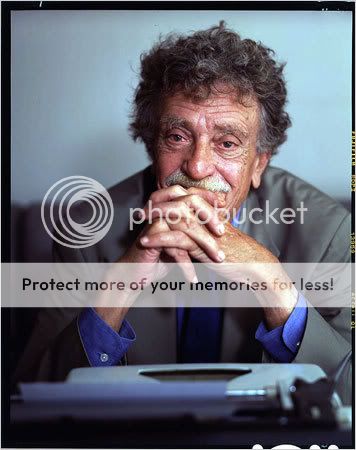
This is a selection of Mr. Vonnegut?s counter cultural thought and moral vision from his novels and articles, including ?Slaughterhouse-Five,? and ?Cat?s Cradle?.
The New York Times compares his work with Mark Twain and correctly notes that
Like Mark Twain, Mr. Vonnegut used humor to tackle the basic questions of human existence: Why are we in this world? Is there a presiding figure to make sense of all this, a god who in the end, despite making people suffer, wishes them well?
If I should ever die, God forbid, let this be my epitaph:
THE ONLY PROOF HE NEEDED
FOR THE EXISTENCE OF GOD
WAS MUSIC
- Vonnegut?s Blues For America 07 January, 2006 Sunday Herald
There is no reason why good cannot triumph as often as evil. The triumph of anything is a matter of organization. If there are such things as angels, I hope that they are organized along the lines of the Mafia.
- The Sirens of Titan (1959)
Anyone who cannot understand how useful a religion based on lies can be will not understand this book either.
- Cat?s Cradle (1963)
Beware of the man who works hard to learn something, learns it, and finds himself no wiser than before? He is full of murderous resentment of people who are ignorant without having come by their ignorance the hard way.
- Cat?s Cradle (1963)
The visitor from outer space made a serious study of Christianity, to learn, if he could, why Christians found it so easy to be cruel. He concluded that at least part of the trouble was slipshod storytelling in the New Testament. He supposed that the intent of the Gospels was to teach people, among other things, to be merciful, even to the lowest of the low.
But the Gospels actually taught this:
Before you kill somebody, make absolutely sure he isn?t well connected. So it goes.
- Slaughterhouse-Five (1969)
Ideas or the lack of them can cause disease.
- Breakfast of Champions (1973)
To be
the eyes
and ears
and conscience
of the Creator of the Universe,
you fool.
: Kilgore Trout?s unwritten reply to the question ?What is the purpose of life??
- Breakfast of Champions (1973)
1492. As children we were taught to memorize this year with pride and joy as the year people began living full and imaginative lives on the continent of North America. Actually, people had been living full and imaginative lives on the continent of North America for hundreds of years before that. 1492 was simply the year sea pirates began to rob, cheat, and kill them.
- Breakfast of Champions (1973)
The two real political parties in America are the Winners and the Losers. The people don?t acknowledge this. They claim membership in two imaginary parties, the Republicans and the Democrats, instead.
- Wampeters, Foma and Granfalloons (1974)
A great swindle of our time is the assumption that science has made religion obsolete. All science has damaged is the story of Adam and Eve and the story of Jonah and the Whale. Everything else holds up pretty well, particularly lessons about fairness and gentleness. People who find those lessons irrelevant in the twentieth century are simply using science as an excuse for greed and harshness. Science has nothing to do with it, friends.
- Wampeters, Foma and Granfalloons (1974)
Congressman Nixon had asked me why, as the son of immigrants who had been treated so well by Americans, as a man who had been treated like a son and been sent to Harvard by an American capitalist, I had been so ungrateful to the American economic system.
The answer I gave him was not original. Nothing about me has ever been original. I repeated what my one-time hero, Kenneth Whistler, had said in reply to the same general sort of question long, long ago. Whistler had been a witness at a trial of strikers accused of violence. The judge had become curious about him, had asked him why such a well-educated man from such a good family would so immerse himself in the working class.
My stolen answer to Nixon was this: ?Why? The Sermon on the Mount, sir.?
- Jailbird (1979)
All persons, living and dead, are purely coincidental.
- Timequake (1996)
All male writers, incidentally, no matter how broke or otherwise objectionable, have pretty wives. Somebody should look into this.
- Timequake (1996)
If you really want to know whether your pictures are, as you say, art or not, you must display them in a public place somewhere, and see if strangers like to look at them. That is the way the game is played. Let me know what happens.
- Timequake (1996)
For some reason, the most vocal Christians among us never mention the Beatitudes. But, often with tears in their eyes, they demand that the Ten Commandments be posted in public buildings. And of course that?s Moses, not Jesus. I haven?t heard one of them demand that the Sermon on the Mount, the Beatitudes, be posted anywhere.
?Blessed are the merciful? in a courtroom? ?Blessed are the peacemakers? in the Pentagon? Give me a break!
- Cold Turkey (2004)
Here?s what I think the truth is: We are all addicts of fossil fuels in a state of denial, about to face cold turkey. And like so many addicts about to face cold turkey, our leaders are now committing violent crimes to get what little is left of what we?re hooked on.
- Cold Turkey (2004)
One of the few good things about modern times: If you die horribly on television, you will not have died in vain. You will have entertained us.
- Cold Turkey (2004)
My last words? ?Life is no way to treat an animal, not even a mouse.?
- I Love You, Madame Librarian
(original article in These Times)
Human beings will be happier ? not when they cure cancer or get to Mars or eliminate racial prejudice or flush Lake Erie ? but when they find ways to inhabit primitive communities again. That?s my utopia.
- Interview Playboy (1973)
Mere opinions, in fact, were as likely to govern people?s actions as hard evidence, and were subject to sudden reversals as hard evidence could never be. So the Galapagos Islands could be hell in one moment and heaven in the next, and Julius Caesar could be a statesman in one moment and a butcher in the next, and Ecuadorian paper money could be traded for food, shelter, and clothing in one moment and line the bottom of a birdcage in the next, and the universe could be created by God Almighty in one moment and by a big explosion in the next? and on and on.
- Galapagos (1985)
The only difference between [George W.] Bush and [Adolf] Hitler is that Hitler was elected.
- ?Kurt Vonnegut?s ?Stardust Memory?, Harvey Wasserman, The Free Press
?finally stopped laughing at his own agony and that of those around him. He denounced life on this planet as a crock. He died.
- Fates Worse Than Death: An Autobiographical Collage (1991)
High school is closer to the core of the American experience than anything else I can think of.
True terror is to wake up one morning and discover that your high school class is running the country.
If you can do a half-assed job of anything, you?re a one-eyed man in a kingdom of the blind.
April 12th, 2007 newslok.com
Kurt Vonnegut, Jr. (November 11, 1922 ? April 11, 2007) (pronounced /ˈvɒnəgət/) was a prolific and genre-bending American novelist known for works blending satire, black comedy, and science fiction, such as Slaughterhouse-Five (1969), Cat's Cradle (1963), and Breakfast of Champions (1973).[2]
Kurt Vonnegut was born to fourth-generation German-American parents, son and grandson of architects in the Indianapolis firm Vonnegut & Bohn, on Armistice Day.[3] As a student at Shortridge High School in Indianapolis,[4] Vonnegut worked on the nation's first daily high school newspaper, The Daily Echo. He attended Cornell University from 1941 to 1942, where he served as assistant managing editor and associate editor for the student newspaper, the Cornell Daily Sun, and majored in biochemistry. While attending Cornell, he was a member of the Delta Upsilon Fraternity, following in the footsteps of his father. While at Cornell, Vonnegut enlisted in the U.S. Army. The army sent him to the Carnegie Institute of Technology (now Carnegie Mellon University) and the University of Tennessee to study mechanical engineering.[2] On May 14, 1944, Mothers' Day, his mother, Edith S. (Lieber) Vonnegut[5], committed suicide.[6
Kurt Vonnegut's experience as a soldier and prisoner of war had a profound influence on his later work. As a Corporal with the 106th Infantry Division, Vonnegut was cut off from his battalion and wandered alone behind enemy lines for several days until captured by Wehrmacht troops on December 14, 1944.[7] Imprisoned in Dresden, Vonnegut witnessed the fire bombing of Dresden in February 1945, which destroyed most of the city. Vonnegut was one of just seven American prisoners of war in Dresden to survive, in their cell in an underground meat locker of a Slaughterhouse that had been converted to a prison camp. The administration building had the postal address Schlachthof F?nf (Slaughterhouse Five) which the prisoners took to using as the name for the whole camp. "Utter destruction", he recalled, "carnage unfathomable." The Germans put him to work gathering bodies for mass burial. "But there were too many corpses to bury. So instead the Nazis sent in troops with flamethrowers. All these civilians' remains were burned to ashes."[8] This experience formed the core of one of his most famous works, Slaughterhouse-Five, and is a theme in at least six other books.[8]
Vonnegut was freed by Red Army troops in May 1945. Upon returning to America, he was awarded a Purple Heart for what he called a "ludicrously negligible wound,"[9] later writing in Timequake that he was given the decoration after suffering a case of "frostbite."[10]
for more....http://en.wikipedia.org/wiki/Kurt_Vonnegut
but it is damn sure worth reading..
This is a selection of Mr. Vonnegut?s counter cultural thought and moral vision from his novels and articles, including ?Slaughterhouse-Five,? and ?Cat?s Cradle?.
The New York Times compares his work with Mark Twain and correctly notes that
Like Mark Twain, Mr. Vonnegut used humor to tackle the basic questions of human existence: Why are we in this world? Is there a presiding figure to make sense of all this, a god who in the end, despite making people suffer, wishes them well?
If I should ever die, God forbid, let this be my epitaph:
THE ONLY PROOF HE NEEDED
FOR THE EXISTENCE OF GOD
WAS MUSIC
- Vonnegut?s Blues For America 07 January, 2006 Sunday Herald
There is no reason why good cannot triumph as often as evil. The triumph of anything is a matter of organization. If there are such things as angels, I hope that they are organized along the lines of the Mafia.
- The Sirens of Titan (1959)
Anyone who cannot understand how useful a religion based on lies can be will not understand this book either.
- Cat?s Cradle (1963)
Beware of the man who works hard to learn something, learns it, and finds himself no wiser than before? He is full of murderous resentment of people who are ignorant without having come by their ignorance the hard way.
- Cat?s Cradle (1963)
The visitor from outer space made a serious study of Christianity, to learn, if he could, why Christians found it so easy to be cruel. He concluded that at least part of the trouble was slipshod storytelling in the New Testament. He supposed that the intent of the Gospels was to teach people, among other things, to be merciful, even to the lowest of the low.
But the Gospels actually taught this:
Before you kill somebody, make absolutely sure he isn?t well connected. So it goes.
- Slaughterhouse-Five (1969)
Ideas or the lack of them can cause disease.
- Breakfast of Champions (1973)
To be
the eyes
and ears
and conscience
of the Creator of the Universe,
you fool.
: Kilgore Trout?s unwritten reply to the question ?What is the purpose of life??
- Breakfast of Champions (1973)
1492. As children we were taught to memorize this year with pride and joy as the year people began living full and imaginative lives on the continent of North America. Actually, people had been living full and imaginative lives on the continent of North America for hundreds of years before that. 1492 was simply the year sea pirates began to rob, cheat, and kill them.
- Breakfast of Champions (1973)
The two real political parties in America are the Winners and the Losers. The people don?t acknowledge this. They claim membership in two imaginary parties, the Republicans and the Democrats, instead.
- Wampeters, Foma and Granfalloons (1974)
A great swindle of our time is the assumption that science has made religion obsolete. All science has damaged is the story of Adam and Eve and the story of Jonah and the Whale. Everything else holds up pretty well, particularly lessons about fairness and gentleness. People who find those lessons irrelevant in the twentieth century are simply using science as an excuse for greed and harshness. Science has nothing to do with it, friends.
- Wampeters, Foma and Granfalloons (1974)
Congressman Nixon had asked me why, as the son of immigrants who had been treated so well by Americans, as a man who had been treated like a son and been sent to Harvard by an American capitalist, I had been so ungrateful to the American economic system.
The answer I gave him was not original. Nothing about me has ever been original. I repeated what my one-time hero, Kenneth Whistler, had said in reply to the same general sort of question long, long ago. Whistler had been a witness at a trial of strikers accused of violence. The judge had become curious about him, had asked him why such a well-educated man from such a good family would so immerse himself in the working class.
My stolen answer to Nixon was this: ?Why? The Sermon on the Mount, sir.?
- Jailbird (1979)
All persons, living and dead, are purely coincidental.
- Timequake (1996)
All male writers, incidentally, no matter how broke or otherwise objectionable, have pretty wives. Somebody should look into this.
- Timequake (1996)
If you really want to know whether your pictures are, as you say, art or not, you must display them in a public place somewhere, and see if strangers like to look at them. That is the way the game is played. Let me know what happens.
- Timequake (1996)
For some reason, the most vocal Christians among us never mention the Beatitudes. But, often with tears in their eyes, they demand that the Ten Commandments be posted in public buildings. And of course that?s Moses, not Jesus. I haven?t heard one of them demand that the Sermon on the Mount, the Beatitudes, be posted anywhere.
?Blessed are the merciful? in a courtroom? ?Blessed are the peacemakers? in the Pentagon? Give me a break!
- Cold Turkey (2004)
Here?s what I think the truth is: We are all addicts of fossil fuels in a state of denial, about to face cold turkey. And like so many addicts about to face cold turkey, our leaders are now committing violent crimes to get what little is left of what we?re hooked on.
- Cold Turkey (2004)
One of the few good things about modern times: If you die horribly on television, you will not have died in vain. You will have entertained us.
- Cold Turkey (2004)
My last words? ?Life is no way to treat an animal, not even a mouse.?
- I Love You, Madame Librarian
(original article in These Times)
Human beings will be happier ? not when they cure cancer or get to Mars or eliminate racial prejudice or flush Lake Erie ? but when they find ways to inhabit primitive communities again. That?s my utopia.
- Interview Playboy (1973)
Mere opinions, in fact, were as likely to govern people?s actions as hard evidence, and were subject to sudden reversals as hard evidence could never be. So the Galapagos Islands could be hell in one moment and heaven in the next, and Julius Caesar could be a statesman in one moment and a butcher in the next, and Ecuadorian paper money could be traded for food, shelter, and clothing in one moment and line the bottom of a birdcage in the next, and the universe could be created by God Almighty in one moment and by a big explosion in the next? and on and on.
- Galapagos (1985)
The only difference between [George W.] Bush and [Adolf] Hitler is that Hitler was elected.
- ?Kurt Vonnegut?s ?Stardust Memory?, Harvey Wasserman, The Free Press
?finally stopped laughing at his own agony and that of those around him. He denounced life on this planet as a crock. He died.
- Fates Worse Than Death: An Autobiographical Collage (1991)
High school is closer to the core of the American experience than anything else I can think of.
True terror is to wake up one morning and discover that your high school class is running the country.
If you can do a half-assed job of anything, you?re a one-eyed man in a kingdom of the blind.
April 12th, 2007 newslok.com
Kurt Vonnegut, Jr. (November 11, 1922 ? April 11, 2007) (pronounced /ˈvɒnəgət/) was a prolific and genre-bending American novelist known for works blending satire, black comedy, and science fiction, such as Slaughterhouse-Five (1969), Cat's Cradle (1963), and Breakfast of Champions (1973).[2]
Kurt Vonnegut was born to fourth-generation German-American parents, son and grandson of architects in the Indianapolis firm Vonnegut & Bohn, on Armistice Day.[3] As a student at Shortridge High School in Indianapolis,[4] Vonnegut worked on the nation's first daily high school newspaper, The Daily Echo. He attended Cornell University from 1941 to 1942, where he served as assistant managing editor and associate editor for the student newspaper, the Cornell Daily Sun, and majored in biochemistry. While attending Cornell, he was a member of the Delta Upsilon Fraternity, following in the footsteps of his father. While at Cornell, Vonnegut enlisted in the U.S. Army. The army sent him to the Carnegie Institute of Technology (now Carnegie Mellon University) and the University of Tennessee to study mechanical engineering.[2] On May 14, 1944, Mothers' Day, his mother, Edith S. (Lieber) Vonnegut[5], committed suicide.[6
Kurt Vonnegut's experience as a soldier and prisoner of war had a profound influence on his later work. As a Corporal with the 106th Infantry Division, Vonnegut was cut off from his battalion and wandered alone behind enemy lines for several days until captured by Wehrmacht troops on December 14, 1944.[7] Imprisoned in Dresden, Vonnegut witnessed the fire bombing of Dresden in February 1945, which destroyed most of the city. Vonnegut was one of just seven American prisoners of war in Dresden to survive, in their cell in an underground meat locker of a Slaughterhouse that had been converted to a prison camp. The administration building had the postal address Schlachthof F?nf (Slaughterhouse Five) which the prisoners took to using as the name for the whole camp. "Utter destruction", he recalled, "carnage unfathomable." The Germans put him to work gathering bodies for mass burial. "But there were too many corpses to bury. So instead the Nazis sent in troops with flamethrowers. All these civilians' remains were burned to ashes."[8] This experience formed the core of one of his most famous works, Slaughterhouse-Five, and is a theme in at least six other books.[8]
Vonnegut was freed by Red Army troops in May 1945. Upon returning to America, he was awarded a Purple Heart for what he called a "ludicrously negligible wound,"[9] later writing in Timequake that he was given the decoration after suffering a case of "frostbite."[10]
for more....http://en.wikipedia.org/wiki/Kurt_Vonnegut