Anyone have a burning satellite in your backyards yet?
- Thread starter PocketAces
- Start date
You are using an out of date browser. It may not display this or other websites correctly.
You should upgrade or use an alternative browser.
You should upgrade or use an alternative browser.
 opcorn2
Who, What, Why: Can you dodge a falling satellite?
just my luck i would be 3199 !:scared
Fragments from a satellite falling to Earth are expected to land on Friday. So is it possible to take evasive action?
A six-tonne satellite is expected to crash land in the next 24 hours, scattering debris over an area of the planet's surface up to 500km (310 miles) wide.
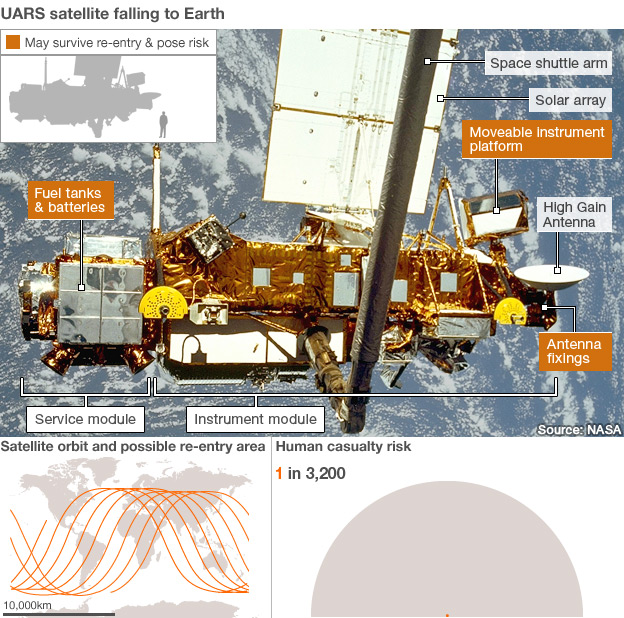
Nasa, which owns the Upper Atmosphere Research Satellite (UARS), estimates it will break into about 26 parts, the heaviest weighing about 158kg, which is equivalent to a very large person.
The debris will include three batteries, four wheel rims and four fuel tanks, and their speed when they hit the ground or the ocean will vary.
The rims, for example, could reach speeds of 107 metres per second (240mph), which is faster than one of France's high-speed TGV trains and 10 times quicker than Usain Bolt.
So is it possible for humans to ensure they don't get hit?
"Potentially, you could get out of the way," says Richard Crowther of the UK Space Agency, which is a member of a global network of agencies that monitors space debris.
"But if you're going to spend all the time looking up then you're at greater risk of an accident bumping into something than something coming down on you."Equally, if you want to avoid the risk of being hit completely, he says, then you need to go beyond 57 degrees latitude north (Scotland or Quebec) or south (further south than the southern tip of Argentina).
"But travelling there will involve a greater risk than the risk of being hit by this."
Even if it is coming to your neighbourhood, you won't get much notice.
Nasa is tracking the object in orbit and said on Thursday that it was expected to re-enter the atmosphere on Friday afternoon on the US east coast (evening in the UK, which is five hours ahead).
But Nasa doesn't know where it will land, partly due to continuous changes in the atmosphere caused by the Sun. And the uncertainty surrounding the satellite's final destination will continue until its final minutes.
In 1979, when the Skylab space station fell to Earth, it missed the expected landing in South Africa and crashed in Western Australia.
just my luck i would be 3199 !:scared
Fragments from a satellite falling to Earth are expected to land on Friday. So is it possible to take evasive action?
A six-tonne satellite is expected to crash land in the next 24 hours, scattering debris over an area of the planet's surface up to 500km (310 miles) wide.
Nasa, which owns the Upper Atmosphere Research Satellite (UARS), estimates it will break into about 26 parts, the heaviest weighing about 158kg, which is equivalent to a very large person.
The debris will include three batteries, four wheel rims and four fuel tanks, and their speed when they hit the ground or the ocean will vary.
The rims, for example, could reach speeds of 107 metres per second (240mph), which is faster than one of France's high-speed TGV trains and 10 times quicker than Usain Bolt.
So is it possible for humans to ensure they don't get hit?
"Potentially, you could get out of the way," says Richard Crowther of the UK Space Agency, which is a member of a global network of agencies that monitors space debris.
"But if you're going to spend all the time looking up then you're at greater risk of an accident bumping into something than something coming down on you."Equally, if you want to avoid the risk of being hit completely, he says, then you need to go beyond 57 degrees latitude north (Scotland or Quebec) or south (further south than the southern tip of Argentina).
"But travelling there will involve a greater risk than the risk of being hit by this."
Even if it is coming to your neighbourhood, you won't get much notice.
Nasa is tracking the object in orbit and said on Thursday that it was expected to re-enter the atmosphere on Friday afternoon on the US east coast (evening in the UK, which is five hours ahead).
But Nasa doesn't know where it will land, partly due to continuous changes in the atmosphere caused by the Sun. And the uncertainty surrounding the satellite's final destination will continue until its final minutes.
In 1979, when the Skylab space station fell to Earth, it missed the expected landing in South Africa and crashed in Western Australia.
As of 8 p.m. EDT on Sept. 23, 2011, the orbit of UARS was 90 miles by 95 miles (145 km by 150 km). Re-entry is expected between 11 p.m. Friday, Sept. 23, and 3 a.m., Sept. 24, Eastern Daylight Time (3 a.m. to 7 a.m. GMT). During that time period, the satellite will be passing over Canada, Africa and Australia, as well as vast areas of the Pacific, Atlantic and Indian oceans. The risk to public safety is very remote.
As of 10:30 p.m. EDT on Sept. 23, 2011, the orbit of UARS was 85 miles by 90 miles (135 km by 140 km). Re-entry is expected between 11:45 p.m. Friday, Sept. 23, and 12:45 a.m., Sept. 24, Eastern Daylight Time (3:45 a.m. to 4:45 a.m. GMT).
During that time period, the satellite will be passing over Canada and Africa, as well as vast areas of the Pacific, Atlantic and Indian oceans.
During that time period, the satellite will be passing over Canada and Africa, as well as vast areas of the Pacific, Atlantic and Indian oceans.



- Mar 19, 2006
- 38,640
- 557
- 113
- 75
NASA satellite lands in unknown location
:SIB
http://news.yahoo.com/dead-nasa-satellite-crash-land-earth-001101999.html
:SIB
http://news.yahoo.com/dead-nasa-satellite-crash-land-earth-001101999.html