David Hastings: What I didn?t say to Gov. Scott about climate change

ChrryBlstr

Registered User
Forum Member
Feb 11, 2002
7,407
54
48
Hoosier country
Published: August 31, 2014

I recently joined fellow climate scientists in a meeting with Gov. Rick Scott to discuss the threat climate change poses to our state. We appreciated the opportunity to have a dialogue with the governor, but we left the meeting with concerns about his willingness to take meaningful action to address this problem. This is a leadership moment for Scott, since Florida is ground zero for the impacts of climate change.

We explained to Scott that the fundamentals of climate science are not complicated. Global temperatures are now at record highs. Sea level is rising. Oceans are more acidic. We are responsible.

That said, global air temperatures have remained more or less constant for the past 15 years. Yes, it?s true! They haven?t changed much since the record-setting year of 1998. And skeptics, including Tampa Tribune columnist Tom Jackson (?Climate professors and Rick Scott?s sphinxian agenda,? Aug. 24, Metro), are eager to discredit the overwhelming majority of climate change scientists and the vast troves of data indicating the severity of human-induced climate change.

Their underlying message is that if the Earth isn?t warming as fast as we think it should be, we can continue our carbon-guzzling ways.

So what?s going on?

The key fact that Jackson and others ignore is that the oceans control the planet?s temperature: 90 percent of the heat is stored in the oceans, and its heat content continues to rise at a rapid rate. Thus, the skeptics miss the elephant and focus on the mouse.

Water holds a lot more heat than air. Your high school physics teacher would say water has a high heat capacity. And she?s right. So although global air temperatures haven?t changed much over the past 15 years, warming of the deep oceans has been unprecedented over the past 50 years and is accelerating. Warming of the oceans causes them to expand and, along with melting ice, causes sea level to rise. And that matters to Floridians.

So, what to do? The costs for inaction increase with every year as sea level rises, streets in Miami are flooded with sea water, fresh drinking water is contaminated by rising seas, intensity of storms increases, and our coral reefs die off. This will cost us all dearly in terms of taxes, insurance, infrastructure needs as well as human health.

But our message to Gov. Scott is actually good news: Solutions are close at hand.

The Clean Power Plan released by the U.S. Environmental Protection Agency in June calls for the reduction of carbon pollution by 38 percent over the next 15 years.

How can we do this?

The governor?s office should embrace a transparent process to develop and implement a state plan to reduce carbon pollution. Florida should:

♦  Phase out coal-burning power plants. Many of these plants are inefficient, and they are the biggest source of human CO2 emissions.

♦  Ramp up energy efficiency. It is the fastest and cheapest way to reduce carbon emissions. Setting meaningful efficiency goals for big utilities will save communities money and reduce harmful emissions of heat-trapping gases.

♦  Advance renewables such as solar power. Solar is an excellent solution for the Sunshine State. The costs for solar have come down dramatically. Germany ? with the cloud cover of Alaska ? produced half of its electricity from solar power one day this June. Why not here in sunny Florida while creating new jobs?

As scientists, we are the map makers. We describe the territory, and provide a sense of the different routes to travel. The policy makers, including the governor and his staff, are the navigators. They choose which route is best.

It is clear ? and the best science is telling us ? that we need to travel a different route.

I hope that Gov. Scott heard our counsel and will work with his staff to put Florida on track to meet our required 38 percent cut in carbon pollution. Taking this action will put our state on a path to meeting the threat posed by climate change.

We look forward to a continued dialogue on how to make that happen.

David Hastings, Ph.D., is a professor of marine science and chemistry at Eckerd College in St. Petersburg.

http://tbo.com/list/news-opinion-commentary/david-hastings-what-i-didnt-say-to-gov-scott-about-climate-change-20140831/
 

Skulnik

Truth Teller
Forum Member
Mar 30, 2007
21,761
1,036
113
Jefferson City, Missouri
1409435267461_Image_galleryImage_polar1.JPG

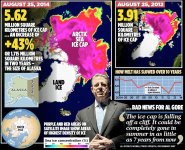
Myth of arctic meltdown: Stunning satellite images show summer ice cap is thicker and covers 1.7million square kilometres MORE than 2 years ago...despite Al Gore's prediction it would be ICE-FREE by now
Seven years after former US Vice-President Al Gore's warning, Arctic ice cap has expanded for second year in row
An area twice the size of Alaska - America's biggest state - was open water two years ago and is now covered in ice
These satellite images taken from University of Illinois's Cryosphere project show ice has become more concentrated
By DAVID ROSE FOR THE MAIL ON SUNDAY
PUBLISHED: 17:04 EST, 30 August 2014 | UPDATED: 03:56 EST, 31 August 2014

16k
shares
1k
View comments
The speech by former US Vice-President Al Gore was apocalyptic. ?The North Polar ice cap is falling off a cliff,? he said. ?It could be completely gone in summer in as little as seven years. Seven years from now.?
Those comments came in 2007 as Mr Gore accepted the Nobel Peace Prize for his campaigning on climate change.
But seven years after his warning, The Mail on Sunday can reveal that, far from vanishing, the Arctic ice cap has expanded for the second year in succession ? with a surge, depending on how you measure it, of between 43 and 63 per cent since 2012.
Scroll down for video

+4
To put it another way, an area the size of Alaska, America?s biggest state, was open water two years ago, but is again now covered by ice.
The most widely used measurements of Arctic ice extent are the daily satellite readings issued by the US National Snow and Ice Data Center, which is co-funded by Nasa. These reveal that ? while the long-term trend still shows a decline ? last Monday, August 25, the area of the Arctic Ocean with at least 15 per cent ice cover was 5.62 million square kilometres.
This was the highest level recorded on that date since 2006 (see graph, right), and represents an increase of 1.71 million square kilometres over the past two years ? an impressive 43 per cent.
Other figures from the Danish Meteorological Institute suggest that the growth has been even more dramatic. Using a different measure, the area with at least 30 per cent ice cover, these reveal a 63 per cent rise ? from 2.7 million to 4.4 million square kilometres.

More...
Will there be a global famine in 2050? Crops will be overwhelmed by pests in the next 30 years, scientists warn
Think California's drought is bad? Scientists issue dire warning of US megadrought that could last 35 YEARS and lead to mass population migrations
Obama will sidestep Congress by signing sweeping international climate change agreement
The satellite images published here are taken from a further authoritative source, the University of Illinois?s Cryosphere project.
They show that as well as becoming more extensive, the ice has grown more concentrated, with the purple areas ? denoting regions where the ice pack is most dense ? increasing markedly.
Crucially, the ice is also thicker, and therefore more resilient to future melting. Professor Andrew Shepherd, of Leeds University, an expert in climate satellite monitoring, said yesterday: ?It is clear from the measurements we have collected that the Arctic sea ice has experienced a significant recovery in thickness over the past year.
?It seems that an unusually cool summer in 2013 allowed more ice to survive through to last winter. This means that the Arctic sea ice pack is thicker and stronger than usual, and this should be taken into account when making predictions of its future extent.?
The speech by former US Vice-President Al Gore (above) was apocalyptic. He said that the North Polar ice cap is falling off a cliff and could be gone in seven years
+4
The speech by former US Vice-President Al Gore (above) was apocalyptic. He said that the North Polar ice cap is falling off a cliff and could be gone in seven years
Yet for years, many have been claiming that the Arctic is in an ?irrevocable death spiral?, with imminent ice-free summers bound to trigger further disasters. These include gigantic releases of methane into the atmosphere from frozen Arctic deposits, and accelerated global warming caused by the fact that heat from the sun will no longer be reflected back by the ice into space.
Judith Curry, professor of earth and atmospheric sciences at Georgia Institute of Technology in Atlanta, said last night: ?The Arctic sea ice spiral of death seems to have reversed.?
Those who just a few years ago were warning of ice-free summers by 2014 included US Secretary of State John Kerry, who made the same bogus prediction in 2009, while Mr Gore has repeated it numerous times ? notably in a speech to world leaders at the UN climate conference in Copenhagen in 2009, in an effort to persuade them to agree a new emissions treaty.
The ice cap is falling off a cliff. It could be completely gone in summer in as little as 7 years from now
Mr Gore ? whose office yesterday failed to respond to a request for comment ? insisted then: ?There is a 75 per cent chance that the entire polar ice cap during some of the summer months could be completely ice-free within five to seven years.?
Misleading as such forecasts are, some people continue to make them. Only last month, while giving evidence to a House of Lords Select Committee inquiry on the Arctic, Cambridge University?s Professor Peter Wadhams claimed that although the Arctic is not ice-free this year, it will be by September 2015.
Asked about this yesterday, he said: ?I still think that it is very likely that by mid-September 2015, the ice area will be less than one million square kilometres ? the official designation of ice-free, implying only a fringe of floes around the coastlines. That is where the trend is taking us.?
For that prediction to come true it would require by far the fastest loss of ice in history. It would also fly in the face of a report last year by the UN Intergovernmental Panel on Climate Change (IPCC), which stated with ?medium confidence? that ice levels would ?likely? fall below one million square kilometres by 2050.
Politicians such as Al Gore have often insisted that climate science is ?settled? and have accused those who question their forecasts of being climate change ?deniers?.
However, while few scientists doubt that carbon-dioxide emissions cause global warming, and that this has caused Arctic ice to decline, there remains much uncertainty about the speed of melting and how much of it is due to human activity. But outside the scientific community, the more pessimistic views have attracted most attention. For example, Prof Wadhams?s forecasts have been cited widely by newspapers and the BBC. But many reject them.

more videos
1234
Watch video ISIS promise to kill captured Kurds in shocking new video
Watch video ISIS executes 250 Syrian soldiers (GRAPHIC CONTENT)
Watch video Amber Rose puts her famous derriere on display
Watch video EXCLUSIVE: Daughter Melissa rushes to Joan River's bedside
Watch video 'It makes no sense' toddler finds out his mum is pregnant
Watch video Joan Rivers & Johnny Carson reminisce about her career...
Watch video Kathy Griffin's naked ice bucket challenge on Kimmel LIVE
Watch video Heartbreaking moment parents disown their Gay son
Watch video Smarty pants Spike helps feed his canine companions dog...
Watch video Trailer: The explosive final season of Sons of Anarchy
Watch video Joan Rivers rushed in cardiac arrest to hospital
Watch video Dad angry after grandfather gives baby Ice Bucket Challenge
An area twice the size of Alaska was open water two years ago and is now covered in ice after the arctic ice cap has expanded for the second year in a row
+4
An area twice the size of Alaska was open water two years ago and is now covered in ice after the arctic ice cap has expanded for the second year in a row
Yesterday Dr Ed Hawkins, who leads an Arctic ice research team at Reading University, said: ?Peter Wadhams?s views are quite extreme compared to the views of many other climate scientists, and also compared to what the IPCC report says.?
Dr Hawkins warned against reading too much into ice increase over the past two years on the grounds that 2012 was an ?extreme low?, triggered by freak weather.
?I?m uncomfortable with the idea of people saying the ice has bounced back,? he said.
However, Dr Hawkins added that the decline seen in recent years was not caused only by global warming. It was, he said, intensified by ?natural variability? ? shifts in factors such as the temperature of the oceans. This, he said, has happened before, such as in the 1920s and 1930s, when ?there was likely some sea ice retreat?.
Dr Hawkins said: ?There is undoubtedly some natural variability on top of the long-term downwards trend caused by the overall warming. This variability has probably contributed somewhat to the post-2000 steep declining trend, although the human-caused component still dominates.?
Like many scientists, Dr Hawkins said these natural processes may be cyclical. If and when they go into reverse, they will cool, not warm, the Arctic, in which case, he said, ?a decade with no declining trend? in ice cover would be ?entirely plausible?.
Peer-reviewed research suggests that at least until 2005, natural variability was responsible for half the ice decline. But exactly how big its influence is remains an open question ? and as both Dr Hawkins and Prof Curry agreed, establishing this is critical to making predictions about the Arctic?s future.
Prof Curry said: ?I suspect that the portion of the decline in the sea ice attributable to natural variability could be even larger than half.
?I think the natural variability component of Arctic sea ice extent is in the process of bottoming out, with a reversal to start within the next decade. And when it does, the reversal period could last for several decades.?
This led her to believe that the IPCC forecast, like Al Gore?s, was too pessimistic.
?Ice-free in 2050 is a possible scenario, but I don?t think it is a likely scenario,? she concluded.
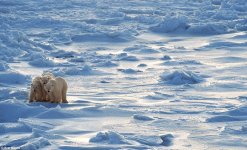
GOOD NEWS FOR POLAR BEARS...

+4
The apparent recovery in Arctic ice looks like good news for polar bears.
If there is more ice at the end of the summer, they can hunt seals more easily. Yet even when the ice reached a low point in 2012, there was no scientific evidence that bear numbers were declining, with their estimated total of 20,000 to 25,000 thought to be higher than in the 1970s, when hunting was first banned.
In many Arctic regions, say scientists, they are in robust health and breeding successfully.
Computer model predictions of decline caused by ice melt have also failed to come true. In 2004, researchers claimed Hudson Bay bear numbers would fall from 900 to fewer than 700 by 2011. In fact, they have risen to over 1,000.
However, the main international bear science body, the Polar Bear Specialist Group, admits it has no reliable data from almost half of the Arctic, so cannot say whether numbers are falling or rising.


Read more: http://www.dailymail.co.uk/news/art...-s-prediction-ICE-FREE-now.html#ixzz3Bz6xx4Wy
Follow us: @MailOnline on Twitter | DailyMail on Facebook
 

Skulnik

Truth Teller
Forum Member
Mar 30, 2007
21,761
1,036
113
Jefferson City, Missouri
[video]http://www.dailymail.co.uk/news/article-2738653/Stunning-satellite-images-summer-ice-cap-thicker-covers-1-7million-square-kilometres-MORE-2-years-ago-despite-Al-Gore-s-prediction-ICE-FREE-now.html#v-3309166287001[/video]
 

ChrryBlstr

Registered User
Forum Member
Feb 11, 2002
7,407
54
48
Hoosier country
?Irreversible? Damage to Planet From Climate Change Says Leaked IPCC Report

?Irreversible? Damage to Planet From Climate Change Says Leaked IPCC Report

Climate change is here, man-made and already having dangerous impacts, according to leaked drafts of the upcoming UN climate science report.

The 127-page final draft of the latest Intergovernmental Panel on Climate Change (IPCC) report shows the effects of global warming are already being felt across all continents and the oceans.

It warns that further emission rises will increase the likelihood of ?severe, pervasive and irreversible impacts for people and ecosystems.?

The report will be a synthesis of the IPCC?s three comprehensive reports released in the past year, which examined the science of climate change, its impacts and potential mitigation options.

The report will be finalised after governments and scientists go over it line-by-line at a meeting in Copenhagen in October.

The leaked report, which has been circulated to several media outlets, shows temperatures have already increased by 0.85?C since 1880?a more rapid shift in the climate than that which heralded the end of the last ice age about 10,000 years ago.

The report mentions several impacts that could ?already be considered dangerous? including extreme weather including heat waves, flooding and drought and rising sea levels.

It also raises the risk that climate change and its impacts could worsen violent conflicts and refugee problems, hinder efforts to grow more food and threaten public health.

Ocean acidification, which comes from the added carbon absorbed by the oceans, could also harm marine life, the draft warns.

?Climate change risks are likely to be high or very high by the end of the 21st century? without sharp reductions in greenhouse gas emissions, it says.

It is hoped the new report will focus minds ahead of the global UN climate talks to take place in Lima, Peru in December, where governments are expected to lay the groundwork for the crucial Paris Summit in late 2015.

It is here where countries have agreed to finalise a new global treaty on climate change.

In 2009, countries had agreed to set a goal of limiting global warming to below 2?C?the international agreed danger threshold for climate change.

However, the leaked IPCC report warns it is increasingly likely the world will shoot past this point, and that limiting warming to within this level would require dramatic and immediate cuts in carbon pollution.

Without action to limit the levels of carbon dioxide released into the atmosphere, it warns temperatures could increase by 2?C by mid-century compared to 1986 to 2005.

But the end of the century, that scenario could bring temperatures that are 3.7?C warming, it warns.

http://ecowatch.com/2014/08/28/ipcc-leaked-climate-change-report/
 

ChrryBlstr

Registered User
Forum Member
Feb 11, 2002
7,407
54
48
Hoosier country
What do the 'Climategate' hacked CRU emails tell us?

What do the 'Climategate' hacked CRU emails tell us?

A number of independent investigations from different countries, universities and government bodies have investigated the stolen emails and found no evidence of wrong doing. Focusing on a few suggestive emails, taken out of context, merely serves to distract from the wealth of empirical evidence for man-made global warming.

Climategate CRU emails suggest conspiracy
?[T]he 1079 emails and 72 documents seem indeed evidence of a scandal involving most of the most prominent scientists pushing the man-made warming theory - a scandal that is one of the greatest in modern science. [?] emails suggesting conspiracy, collusion in exaggerating warming data, possibly illegal destruction of embarrassing information, organised resistance to disclosure, manipulation of data, private admissions of flaws in their public claims and much more.? (Andrew Bolt, Herald Sun)

In November 2009, the servers at the University of East Anglia in Britain were illegally hacked and emails were stolen. When a selection of emails between climate scientists were published on the internet, a few suggestive quotes were seized upon by many claiming global warming was all just a conspiracy. A number of independent enquiries have investigated the conduct of the scientists involved in the emails. All have cleared the scientists of any wrong doing:

In February 2010, the Pennsylvania State University released an Inquiry Report that investigated any 'Climategate' emails involving Dr Michael Mann, a Professor of Penn State's Department of Meteorology. They found that "there exists no credible evidence that Dr. Mann had or has ever engaged in, or participated in, directly or indirectly, any actions with an intent to suppress or to falsify data". On "Mike's Nature trick", they concluded "The so-called ?trick?1 was nothing more than a statistical method used to bring two or more different kinds of data sets together in a legitimate fashion by a technique that has been reviewed by a broad array of peers in the field."
In March 2010, the UK government's House of Commons Science and Technology Committee published a report finding that the criticisms of the Climate Research Unit (CRU) were misplaced and that CRU?s "Professor Jones?s actions were in line with common practice in the climate science community".
In April 2010, the University of East Anglia set up an international Scientific Assessment Panel, in consultation with the Royal Society and chaired by Professor Ron Oxburgh. The Report of the International Panel assessed the integrity of the research published by the CRU and found "no evidence of any deliberate scientific malpractice in any of the work of the Climatic Research Unit".
In June 2010, the Pennsylvania State University published their Final Investigation Report, determining "there is no substance to the allegation against Dr. Michael E. Mann".
In July 2010, the University of East Anglia published the Independent Climate Change Email Review report. They examined the emails to assess whether manipulation or suppression of data occurred and concluded that "we find that their rigour and honesty as scientists are not in doubt."
In July 2010, the US Environmental Protection Agency investigated the emails and "found this was simply a candid discussion of scientists working through issues that arise in compiling and presenting large complex data sets."
In September 2010, the UK Government responded to the House of Commons Science and Technology Committee report, chaired by Sir Muir Russell. On the issue of releasing data, they found "In the instance of the CRU, the scientists were not legally allowed to give out the data". On the issue of attempting to corrupt the peer-review process, they found "The evidence that we have seen does not suggest that Professor Jones was trying to subvert the peer review process. Academics should not be criticised for making informal comments on academic papers".
In February 2011, the Department of Commerce Inspector General conducted an independent review of the emails and found "no evidence in the CRU emails that NOAA inappropriately manipulated data".
In August 2011, the National Science Foundation concluded "Finding no research misconduct or other matter raised by the various regulations and laws discussed above, this case is closed".

Just as there are many independent lines of evidence that humans are causing global warming, similarly a number of independent investigations have found no evidence of falsification or conspiracy by climate scientists.
"Mike's Nature trick" and "hide the decline"

The most quoted email is from Phil Jones discussing paleo-data used to reconstruct past temperatures (emphasis mine):

"I've just completed Mike's Nature trick of adding in the real temps to each series for the last 20 years (ie from 1981 onwards) and from 1961 for Keith's to hide the decline."

"Mike's Nature trick" refers to a technique (aka "trick of the trade") used in a paper published in Nature by lead author Michael Mann (Mann 1998). The "trick" is the technique of plotting recent instrumental data along with the reconstructed data. This places recent global warming trends in the context of temperature changes over longer time scales.

The most common misconception regarding this email is the assumption that "decline" refers to declining temperatures. It actually refers to a decline in the reliability of tree rings to reflect temperatures after 1960. This is known as the "divergence problem" where tree ring proxies diverge from modern instrumental temperature records after 1960. The divergence problem is discussed in the peer reviewed literature as early as 1995, suggesting a change in the sensitivity of tree growth to temperature in recent decades (Briffa 1998). It is also examined more recently in Wilmking 2008 which explores techniques in eliminating the divergence problem. So when you look at Phil Jone's email in the context of the science discussed, it is not the schemings of a climate conspiracy but technical discussions of data handling techniques available in the peer reviewed literature. More on the hockey stick divergence problem...
Trenberth's "travesty we can't account for the lack of warming"

The second most cited email is from climate scientist and IPCC lead author Kevin Trenberth. The highlighted quote is this: "The fact is that we can't account for the lack of warming at the moment and it is a travesty that we can't." This has been most commonly interpreted (among skeptics) as climate scientists secretly admitting amongst themselves that global warming really has stopped. Trenberth is actually discussing a paper he'd recently published that discusses the planet's energy budget - how much net energy is flowing into our climate and where it's going (Trenberth 2009).

In Trenberth's paper, he discusses how we know the planet is continually heating due to increasing carbon dioxide. Nevertheless, surface temperature sometimes shows short term cooling periods. This is due to internal variability and Trenberth was lamenting that our observation systems can't comprehensively track all the energy flow through the climate system. More on Trenberth's travesty...
The full body of evidence for man-made global warming

An important point to realise is that the emails involve a handful of scientists discussing a few pieces of climate data. Even without this data, there is still an overwhelming and consistent body of evidence, painstakingly compiled by independent scientific teams from institutions across the world.

What do they find? The planet is steadily accumulating heat. When you add up all the heat building in the oceans, land and atmosphere plus the energy required to melt glaciers and ice sheets, the planet has been accumulating heat at a rate of 190,260 Gigawatts over the past 40 years (Murphy 2009). Considering a typical nuclear power plant has an output of 1 Gigawatt, imagine over 190,000 power plants pouring their energy output directly into heating our land and oceans, melting ice and warming the air.

This build-up of heat is causing ice loss across the globe, from the Arctic to the Antarctic. Both Greenland and Antarctica are losing ice at an accelerated rate (Velicogna 2009, ). Even East Antarctica, previously thought to be too cold and stable, is now losing ice mass (Chen 2009). Glacier shrinkage is accelerating. Arctic sea ice has fallen so sharply, observations exceed even the IPCC worst case scenario. The combination of warming oceans and melting ice has resulted in sea level rise tracking the upper limit of IPCC predictions.

Rising temperatures have impacted animal and plant species worldwide. The distribution of tree lines, plants and many species of animals are moving into cooler regions towards the poles. As the onset of spring is happening earlier each year, animal and plant species are responding to the shift in seasons. Scientists observe that frog breeding, bird nesting, flowering and migration patterns are all occurring earlier in the year (Parmeson 2003). There are many other physical signs of widespread warming. The height of the tropopause, a layer in our atmosphere, is rising (Santer 2003). Arctic permafrost, covering about 25% of Northern Hemisphere land, is warming and degrading (Walsh 2009). The tropical belt is widening (Seidel 2007). These results are all consistent with global warming.

What?s causing this heat build-up? Humans are emitting huge amounts of carbon dioxide into the atmosphere - 29 billion tonnes in 2009 (CDIAC). Greenhouse theory predicts that more carbon dioxide in the atmosphere will trap heat energy as it escapes out to space. What do we observe? Carbon dioxide absorbs heat at certain wavelengths. Satellites over the past 40 years find less heat escaping to space at these wavelengths (Harries 2001, Griggs 2004, Chen 2007). Where does the heat go? Surface measurements find more heat returning back to the Earth's surface (Philipona 2004). Tellingly, the increase occurs at those same carbon dioxide absorption wavelengths (Evans 2006). This is the human fingerprint in global warming.

There are multiple lines of empirical evidence that global warming is happening and human activity is the cause. A few suggestive emails may serve as a useful distraction for those wishing to avoid the physical realities of climate change. But they change nothing about our scientific understanding of humanity?s role in global warming.

http://www.skepticalscience.com/Climategate-CRU-emails-hacked.htm
 

Skulnik

Truth Teller
Forum Member
Mar 30, 2007
21,761
1,036
113
Jefferson City, Missouri
IPCC Scientists Caught Producing False Data To Push Global
www.prisonplanet.com/ipcc-scientists-caught-producing-false-data-to-pu...
Nov 17, 2008 - Al Gore-linked Goddard Institute claimed ?hottest October on record? after using temperature figures from September. IPCC Scientists Caught ...
Fakegate: The Obnoxious Fabrication of Global Warming
www.forbes.com/.../fakegate-the-obnoxious-fabrication-of-global...
Forbes
Mar 1, 2012 - Two years after each AR, the IPCC produces an updating Interim Report. ... alarmist movement plotting to falsify climate data and exclude those ... to go farther and composed a fake memo titled ?Confidential Memo: 2012 ...
Re: "IPCC Scientists Caught Producing False Data To Push ...
https://groups.google.com/d/topic/alt.global-warming/Gwe35Su1Dwc
Nov 17, 2008 - http://www.prisonplanet.com/ipcc-scientists-caught-producing-false-data-to-push-global-warming.html. "IPCC Scientists Caught Producing ...
Top climate scientists admit global warming forecasts were ...
www.telegraph.co.uk ? ... ? Climate Change
The Daily Telegraph
Sep 15, 2013 - The IPCC maintain that they are 95 per cent certain that global ... Scientist were constantly revising their research to account for new data, he said. ... Ignorance of the sky can not only produce trivial fantasies, like a belief in ...
IPCC Scientists Caught Producing False Data To Push ...
www.democraticunderground.com/.../duboard....
Democratic Underground
Nov 30, 2008 - 42 posts - ‎20 authors
IPCC Scientists Caught Producing False Data To Push Global ... that the UN's Intergovernmental Panel on Climate Change (IPCC) relies on to ...
IPCC Scientists Caught Producing False Data To Push ...
uncensored.co.nz/.../ipcc-scientists-caught-producing-false-data-to-push-...
Nov 18, 2008 - How can Government justify the payment of carbon taxes when the IPCC, which is the chief body in charge of justifying them, has been caught ...
Environment IPCC Scientists Caught Producing False Data To Push ...
www.chiefsplanet.com ? ChiefsPlanet ? The Ed & Dave Lounge ? DC
Nov 17, 2008 - 24 posts - ‎12 authors
Climate scientists allied with the IPCC have been caught citing fake data to make the case that global warming is accelerating, a shocking ...
Environment IPCC Scientists Caught Producing False Data ...
www.chiefsplanet.com ? ... ? The GET IN MAH BELLY! Lounge ? DC
Nov 17, 2008 - 15 posts - ‎10 authors
Climate scientists allied with the IPCC have been caught citing fake data to make the case that global warming is accelerating, a shocking ...
CLIMATEGATE - IPCC Scientists Caught Producing False ...
whatreallyhappened.com/.../climategate-ipcc-scientists-caught-producing...
Dec 13, 2009 - CLIMATEGATE - IPCC Scientists Caught Producing False Data To Push Global Warming. Al Gore-linked Goddard Institute claimed ?hottest ...
Alaskan Glaciers Grow For First Time In 250 Years - YouTube
Video for ipcc caught producing false data► 2:38► 2:38
www.youtube.com/watch?v=-GUnkIV1gyQ
Oct 17, 2008 - Uploaded by FireThunderTV
Glaciers in Alaska did not melt, but grew this year. Global "Warming" DEBUNKED! IPCC Scientists Caught ...

:142smilie
 
Bet on MyBookie
Top