My Advice for the Next Time You're Asked to Bake a Gay Wedding Cake
May 11, 2015
Listen to it Button
Windows Icon
Listen to it Button
Windows Icon
Windows Media
BEGIN TRANSCRIPT
RUSH: There are rolling themes on this program. There are umbrella items under which fall a number of, oh, stories and sub-ideas, sub-topics, if you will. One of the themes of this program for its duration since we started, and actually predating this program going back to when I was in Sacramento, has been that the American left and the Democrat Party are engaged in an escalating -- and it has been escalating year after year after year -- attack on the institutions and traditions that have defined and made American greatness. Not just political institutions, but social institutions and traditions and cultural institutions and traditions.
And it's not stopped. And every so often there is a new line of attack. Some of the items that are attacked and assaulted are huge, like marriage. Marriage is an institution and tradition that has been in the crosshairs of the American left for as long as they have had a hatred of religion. They have made repeated, consistent efforts to undermine the tradition of marriage, and they've succeeded. They're well on their way to rendering the whole point of marriage new, different, and meaningless as it relates to the primary reason it even came into existence.
There are many things like this that the left is -- religion, as a giant topic and things that come underneath this, such as gay marriage...speaking of, I got an idea. I thought of something over the weekend, because the left is not through promoting gay marriage. Now, what has happened is that the resistance to gay rights and gay marriage is practically gone, so they've had to come up with a new substitute for it in order to keep the protest meme or narrative alive. And that has resulted in now a major push for equality and fairness and justice for lesbians, gays, and transgenders and bisexual people.
Since gay marriage is a fait accompli, no matter what the Supreme Court says, it's a fait accompli, up next, transgenders. They will be the next aggrieved victimhood or group of victims that will require attention, and the majority will need to be attacked as discriminatory and mean in order to pave the way for the normalcy of the transgendered status of human beings. That's just a little aside. And, in fact, we've already seen this.
But here is an idea I've got because they're not through. I mean, they never give up. To them, nothing is ever mission accomplished, because there's always gonna be some holdouts. There's always gonna be some people that oppose normalizing gay rights and agreeing to the concept of gay marriage and redefining it. There's always gonna be holdouts. There will always be religious people that own businesses that will refuse to serve or do business with people promoting activity that violate someone's religious practices. So to date we've had gay activist groups target bakeries and photography stores and similar types of things in order to prove discrimination, to show a bias and to beat down opposition.
Well, one of the things we've learned recently, and frankly I'm pleasantly surprised by this, that so many people on the left have agreed with me. We go out of our way to not offend Muslims, and we chastise anybody who does anything along the lines of, say, drawing cartoon characters of the prophet Mohammed, right? We don't permit that. We frown on that, and we condemn anybody that does that, because, why? Well, there's no need to provoke millions and millions of Islamic people, Muslims who are not terrorists. Why do it, and anybody who engages in a cartoon rendering of the prophet Mohammed is chastised and ripped to shreds and criticized because we dare not offend our Muslim brothers and sisters.
I pointed out the other day, well, then should we maybe stop flouting and flaunting gay marriage, because gay marriage is really disapproved in Islam. Gay marriage, homosexual behavior is not tolerated, it is not permitted, and it is punished severely when it is caught, when it's spied. And yet in American media all over the place we are celebrating gay marriage, we are flaunting gay marriage, and I ask, does this not also offend Muslims?
Where do we draw the line, I asked poignantly, in what aspects of Islam we will respect and others we will ignore. When it comes to pictures of the cartoon drawings of the prophet, we will absolutely obey the demands of militant Islam and we will not only refrain from drawing cartoons, we will condemn and seek to destroy anybody who does. But MSNBC, CNN, TIME magazine, the New York Times can readily, happily promote gay marriage and gay rights all day long, and the Muslims are supposed shut up about it?
Why, on the one hand, do we respect their wishes when it comes to cartoon renderings of the prophet Mohammed and ignore their wishes and ignore what they claim upsets them and angers them when it comes to gay marriage? Therefore I have an idea. I know that many of you out there run businesses that if a gay couple, a married gay couple came in and asked for your service, you would deny it on the basis that you disapprove, your religion does not sanction the approval of gay marriage.
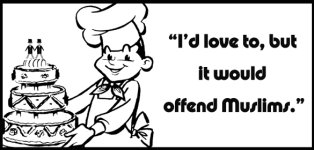
My idea for you is quite simple. Don't use that as the excuse anymore. Let's say that you own the ABC wedding cake bakery. The only thing you do is you bake wedding cakes. And as such, militant gay activists target your bakery. They're gonna take you out, they're gonna take you down, they're gonna walk in there, they're gonna tell you they're gonna get married, and of all the bakeries in the world, yours has been recommended to them because that's all you do, therefore you must be better than anybody else at baking wedding cakes.
Instead of telling the gay couple that you refuse to bake the cake for their wedding because you disapprove of homosexuality, you should now say you are not going to bake a cake for the gay wedding because you fear Muslim backlash. Or, due to your respect of Islam, you cannot bake a cake for a gay wedding. See how that flies. Since the left is agreeing, a bunch of people on the left have gone on TV, "I hate to say this, you know, Limbaugh's got a point. We do flaunt gay marriage at 'em, wow. Wow. That's a good point. I mean, we readily agree not to do the thing with the prophet and the pictures and the cartoons, but gay marriage, yeah, we're kind of in their face on that."
Well, just make a note. Any of you small business owners who think you're gonna get a visit from a gay couple asking you for your product or service at a gay wedding just say, "Nah, nah, nah, we refuse because of our respect of Islam. We can't." Don't say anything about your religion. Don't say anything about it's your religion that prevents you from doing it. Say it's Islam. You respect Islam or you're afraid of Muslim backlash. See how that flies. It's just an idea. Hope it works.
END TRANSCRIPT
May 11, 2015
Listen to it Button
Windows Icon
Listen to it Button
Windows Icon
Windows Media
BEGIN TRANSCRIPT
RUSH: There are rolling themes on this program. There are umbrella items under which fall a number of, oh, stories and sub-ideas, sub-topics, if you will. One of the themes of this program for its duration since we started, and actually predating this program going back to when I was in Sacramento, has been that the American left and the Democrat Party are engaged in an escalating -- and it has been escalating year after year after year -- attack on the institutions and traditions that have defined and made American greatness. Not just political institutions, but social institutions and traditions and cultural institutions and traditions.
And it's not stopped. And every so often there is a new line of attack. Some of the items that are attacked and assaulted are huge, like marriage. Marriage is an institution and tradition that has been in the crosshairs of the American left for as long as they have had a hatred of religion. They have made repeated, consistent efforts to undermine the tradition of marriage, and they've succeeded. They're well on their way to rendering the whole point of marriage new, different, and meaningless as it relates to the primary reason it even came into existence.
There are many things like this that the left is -- religion, as a giant topic and things that come underneath this, such as gay marriage...speaking of, I got an idea. I thought of something over the weekend, because the left is not through promoting gay marriage. Now, what has happened is that the resistance to gay rights and gay marriage is practically gone, so they've had to come up with a new substitute for it in order to keep the protest meme or narrative alive. And that has resulted in now a major push for equality and fairness and justice for lesbians, gays, and transgenders and bisexual people.
Since gay marriage is a fait accompli, no matter what the Supreme Court says, it's a fait accompli, up next, transgenders. They will be the next aggrieved victimhood or group of victims that will require attention, and the majority will need to be attacked as discriminatory and mean in order to pave the way for the normalcy of the transgendered status of human beings. That's just a little aside. And, in fact, we've already seen this.
But here is an idea I've got because they're not through. I mean, they never give up. To them, nothing is ever mission accomplished, because there's always gonna be some holdouts. There's always gonna be some people that oppose normalizing gay rights and agreeing to the concept of gay marriage and redefining it. There's always gonna be holdouts. There will always be religious people that own businesses that will refuse to serve or do business with people promoting activity that violate someone's religious practices. So to date we've had gay activist groups target bakeries and photography stores and similar types of things in order to prove discrimination, to show a bias and to beat down opposition.
Well, one of the things we've learned recently, and frankly I'm pleasantly surprised by this, that so many people on the left have agreed with me. We go out of our way to not offend Muslims, and we chastise anybody who does anything along the lines of, say, drawing cartoon characters of the prophet Mohammed, right? We don't permit that. We frown on that, and we condemn anybody that does that, because, why? Well, there's no need to provoke millions and millions of Islamic people, Muslims who are not terrorists. Why do it, and anybody who engages in a cartoon rendering of the prophet Mohammed is chastised and ripped to shreds and criticized because we dare not offend our Muslim brothers and sisters.
I pointed out the other day, well, then should we maybe stop flouting and flaunting gay marriage, because gay marriage is really disapproved in Islam. Gay marriage, homosexual behavior is not tolerated, it is not permitted, and it is punished severely when it is caught, when it's spied. And yet in American media all over the place we are celebrating gay marriage, we are flaunting gay marriage, and I ask, does this not also offend Muslims?
Where do we draw the line, I asked poignantly, in what aspects of Islam we will respect and others we will ignore. When it comes to pictures of the cartoon drawings of the prophet, we will absolutely obey the demands of militant Islam and we will not only refrain from drawing cartoons, we will condemn and seek to destroy anybody who does. But MSNBC, CNN, TIME magazine, the New York Times can readily, happily promote gay marriage and gay rights all day long, and the Muslims are supposed shut up about it?
Why, on the one hand, do we respect their wishes when it comes to cartoon renderings of the prophet Mohammed and ignore their wishes and ignore what they claim upsets them and angers them when it comes to gay marriage? Therefore I have an idea. I know that many of you out there run businesses that if a gay couple, a married gay couple came in and asked for your service, you would deny it on the basis that you disapprove, your religion does not sanction the approval of gay marriage.
My idea for you is quite simple. Don't use that as the excuse anymore. Let's say that you own the ABC wedding cake bakery. The only thing you do is you bake wedding cakes. And as such, militant gay activists target your bakery. They're gonna take you out, they're gonna take you down, they're gonna walk in there, they're gonna tell you they're gonna get married, and of all the bakeries in the world, yours has been recommended to them because that's all you do, therefore you must be better than anybody else at baking wedding cakes.
Instead of telling the gay couple that you refuse to bake the cake for their wedding because you disapprove of homosexuality, you should now say you are not going to bake a cake for the gay wedding because you fear Muslim backlash. Or, due to your respect of Islam, you cannot bake a cake for a gay wedding. See how that flies. Since the left is agreeing, a bunch of people on the left have gone on TV, "I hate to say this, you know, Limbaugh's got a point. We do flaunt gay marriage at 'em, wow. Wow. That's a good point. I mean, we readily agree not to do the thing with the prophet and the pictures and the cartoons, but gay marriage, yeah, we're kind of in their face on that."
Well, just make a note. Any of you small business owners who think you're gonna get a visit from a gay couple asking you for your product or service at a gay wedding just say, "Nah, nah, nah, we refuse because of our respect of Islam. We can't." Don't say anything about your religion. Don't say anything about it's your religion that prevents you from doing it. Say it's Islam. You respect Islam or you're afraid of Muslim backlash. See how that flies. It's just an idea. Hope it works.
END TRANSCRIPT