

Both Bush and Democratic party leaders agree on basics of immigrant guest worker program. Time Magazine poll in March found 79% of Americans in favor of some form of it. Last bill was sponsored by Senators McCain and Kennedy.
Bush carried over 40% of Hispanic vote in one election, and he knows GOP can't alienate this fast growing population---John Hopkins study reported "Growth in the voting-age Hispanic population is projected to account for 44% of the
growth in total voting age population between 2004 and 2020."
There isn't much downside to Republicans supporting this stuff as Michael Barone observed other day:
A final note on populism. In cycle after cycle, we hear that certain forms
of populism?full-throated opposition to immigration and free trade?will
sweep all before them.
The 2006 results, at least as I see them now,
provide less than full-throated support for this proposition. Two of
the loudest critics of illegal immigration?-incumbent J. D. Hayworth
and open seat primary winner Randy Graf, both in Arizona, where
illegals have been famously streaming through the border-?both
evidently lost.
And in upstate New York, where National Republican
Campaign Committee Chairman Tom Reynolds was in terrible trouble
after the Mark Foley scandal broke, his Republican-turned-Democratic
opponent Jack Davis also lost, in a region where there had been a
huge loss of manufacturing jobs.
Nativism and protectionism are
political weapons that in a certain light look very strong, which
seem to be gleaming swords that will slay all before them. But,
again and again, they crack like glass in your hand. If nativism
can't work on the Arizona border, and protectionism can't work
in upstate New York, where can they work?
.................
and this piece presents another reason Bush might support it, help himself employing a similar strategy used by Lyndon Johnson (smurphy's gotta like that combo!):
TCS Daily - Walls Are for Losers
By Nathan Smith | 08 Nov 2006
The Ming dynasty emperors in China (1368-1644) were the
biggest builders of the famous Great Wall. A native Chinese
dynasty coming to power in the wake of a Mongol occupation,
they wanted to strengthen their defenses against the nomadic
peoples to the north. But a Manchu army crossed over it and
conquered them anyway.
In the years after World War I, France, recognizing its
weakness vis-?-vis Germany, built a supposedly invincible
fortification along its frontier with Germany called the
Maginot Line. Built very high, of concrete and steel, with
forts at 10-mile intervals, the wall nonetheless failed to
prevent Germany from conquering France with lightning speed in
1940.
In 1961 the Communist regime of East Germany found itself
suffering from mass emigration to the freer and more
prosperous West. To prevent this outflow they built the Berlin
Wall. When the workers of East Germany tore down that wall,
they brought down the East German regime with it.
The lesson of history? Walls are for losers.
America doesn't have a frontier with hostile barbarians who
want to conquer us. Instead, we have a frontier with friendly
Mexicans who want to work for and with us. Nonetheless, the
historical pattern?walls are for losers?still applies. It
plays itself out, not in battles or revolutions, but in
elections.
From 1991 to 1999, Pete Wilson was governor of California, a
state where Republicans had long been competitive. Indeed,
California was the home state of Republican presidents Richard
Nixon and Ronald Reagan. Pete Wilson was a prominent supporter
of Proposition 187, a harsh crackdown on illegal immigration
(later overturned by the courts). Since then (at least until
Arnold), the Republican Party's support in California has
collapsed.
In 2005, Jerry Kilgore and Tim Kaine faced off in the race for
governor of Virginia. Virginia is a Republican-leaning state
which Bush won easily in 2004. But Kilgore ran as an
anti-immigration candidate and lost.
Also in 2005, Republicans in the House of Representatives
passed HR4437, a fiercely anti-immigrant bill which would have
legally defined millions of peaceful, though undocumented
workers, as felons. It criminalized those who assisted illegal
immigrants as well, and could have led to the jailing of
Catholic clergy who ministered to them. (Cardinal Mahoney of
Los Angeles pointed out that the bill would oblige the
Catholic Church to engage, not for the first time, in civil
disobedience.)
That bill didn't get through the Senate, but another one did.
This fall both the House and Senate passed the Secure Fence
Act, authorizing a 700-mile fence along the southern border.
President Bush signed the bill on October 26.
Republicans had held the House of Representatives for twelve
years. After the fence bill was signed, they lasted just
twelve days before the voters gave them the boot. Of course
immigration wasn't the only, or the main, issue; Iraq was.
Nonetheless, the "walls are for losers" pattern has claimed
another scalp. Meanwhile, even the Republican Senate, which,
before the fence bill, hardly anyone thought was even in play,
looks at present writing like it may have fallen to the
Democrats.
Why do politicians who take a stance against immigration keep
losing?especially when more Americans want reduced immigration
(40%) as opposed to the present level (37%) or increased
(17%)?
For one thing, though Americans may prefer less immigration
personally, they may understand that the government has, and
should have, only limited say in immigration levels. The
immigration decision should be in the hands of the immigrant.
Americans hate high gas prices, too, but at least some of them
understand that these are, and should be, a function of market
forces.
But the main reason is probably simpler: the political
spectrum. Swing voters are in the center. When Republicans
crack down on immigration, they lose votes in the center, and
gain none on the right, since they had those anyway. It's a
guaranteed net loss. It should have been obvious that signing
the fence bill on the eve of the election could only be
troublesome for Republicans. Congressmen get reams of letters
from angry types who want to close the borders. This time,
they listened to the siren song.
Despite signing the fence bill, President Bush has long
supported a path to citizenship for illegal immigrants. As he
said in January 2004:
"Many undocumented workers have walked mile after mile,
through the heat of the day and the cold of the night. Some
have risked their lives in dangerous desert border crossings,
or entrusted their lives to the brutal rings of heartless
human smugglers. Workers who seek only to earn a living end up
in the shadows of American life -- fearful, often abused and
exploited. When they are victimized by crime, they are afraid
to call the police, or seek recourse in the legal system. They
are cut off from their families far away, fearing if they
leave our country to visit relatives back home, they might
never be able to return to their jobs.
"The situation I described is wrong. It is not the American
way."
Now, with the Democrats in charge of one or both Houses of
Congress, President Bush?like another Texan president
overseeing an unpopular war, Lyndon Johnson?may have his
chance to improve his legacy by achieving a major civil rights
advance.
Nathan Smith is a writer living in Washington, D.C.
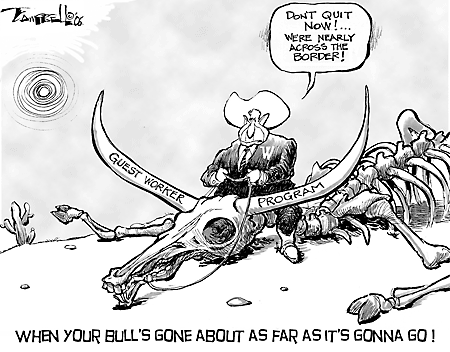
given a new life?
Bush carried over 40% of Hispanic vote in one election, and he knows GOP can't alienate this fast growing population---John Hopkins study reported "Growth in the voting-age Hispanic population is projected to account for 44% of the
growth in total voting age population between 2004 and 2020."
There isn't much downside to Republicans supporting this stuff as Michael Barone observed other day:
A final note on populism. In cycle after cycle, we hear that certain forms
of populism?full-throated opposition to immigration and free trade?will
sweep all before them.
The 2006 results, at least as I see them now,
provide less than full-throated support for this proposition. Two of
the loudest critics of illegal immigration?-incumbent J. D. Hayworth
and open seat primary winner Randy Graf, both in Arizona, where
illegals have been famously streaming through the border-?both
evidently lost.
And in upstate New York, where National Republican
Campaign Committee Chairman Tom Reynolds was in terrible trouble
after the Mark Foley scandal broke, his Republican-turned-Democratic
opponent Jack Davis also lost, in a region where there had been a
huge loss of manufacturing jobs.
Nativism and protectionism are
political weapons that in a certain light look very strong, which
seem to be gleaming swords that will slay all before them. But,
again and again, they crack like glass in your hand. If nativism
can't work on the Arizona border, and protectionism can't work
in upstate New York, where can they work?
.................
and this piece presents another reason Bush might support it, help himself employing a similar strategy used by Lyndon Johnson (smurphy's gotta like that combo!):
TCS Daily - Walls Are for Losers
By Nathan Smith | 08 Nov 2006
The Ming dynasty emperors in China (1368-1644) were the
biggest builders of the famous Great Wall. A native Chinese
dynasty coming to power in the wake of a Mongol occupation,
they wanted to strengthen their defenses against the nomadic
peoples to the north. But a Manchu army crossed over it and
conquered them anyway.
In the years after World War I, France, recognizing its
weakness vis-?-vis Germany, built a supposedly invincible
fortification along its frontier with Germany called the
Maginot Line. Built very high, of concrete and steel, with
forts at 10-mile intervals, the wall nonetheless failed to
prevent Germany from conquering France with lightning speed in
1940.
In 1961 the Communist regime of East Germany found itself
suffering from mass emigration to the freer and more
prosperous West. To prevent this outflow they built the Berlin
Wall. When the workers of East Germany tore down that wall,
they brought down the East German regime with it.
The lesson of history? Walls are for losers.
America doesn't have a frontier with hostile barbarians who
want to conquer us. Instead, we have a frontier with friendly
Mexicans who want to work for and with us. Nonetheless, the
historical pattern?walls are for losers?still applies. It
plays itself out, not in battles or revolutions, but in
elections.
From 1991 to 1999, Pete Wilson was governor of California, a
state where Republicans had long been competitive. Indeed,
California was the home state of Republican presidents Richard
Nixon and Ronald Reagan. Pete Wilson was a prominent supporter
of Proposition 187, a harsh crackdown on illegal immigration
(later overturned by the courts). Since then (at least until
Arnold), the Republican Party's support in California has
collapsed.
In 2005, Jerry Kilgore and Tim Kaine faced off in the race for
governor of Virginia. Virginia is a Republican-leaning state
which Bush won easily in 2004. But Kilgore ran as an
anti-immigration candidate and lost.
Also in 2005, Republicans in the House of Representatives
passed HR4437, a fiercely anti-immigrant bill which would have
legally defined millions of peaceful, though undocumented
workers, as felons. It criminalized those who assisted illegal
immigrants as well, and could have led to the jailing of
Catholic clergy who ministered to them. (Cardinal Mahoney of
Los Angeles pointed out that the bill would oblige the
Catholic Church to engage, not for the first time, in civil
disobedience.)
That bill didn't get through the Senate, but another one did.
This fall both the House and Senate passed the Secure Fence
Act, authorizing a 700-mile fence along the southern border.
President Bush signed the bill on October 26.
Republicans had held the House of Representatives for twelve
years. After the fence bill was signed, they lasted just
twelve days before the voters gave them the boot. Of course
immigration wasn't the only, or the main, issue; Iraq was.
Nonetheless, the "walls are for losers" pattern has claimed
another scalp. Meanwhile, even the Republican Senate, which,
before the fence bill, hardly anyone thought was even in play,
looks at present writing like it may have fallen to the
Democrats.
Why do politicians who take a stance against immigration keep
losing?especially when more Americans want reduced immigration
(40%) as opposed to the present level (37%) or increased
(17%)?
For one thing, though Americans may prefer less immigration
personally, they may understand that the government has, and
should have, only limited say in immigration levels. The
immigration decision should be in the hands of the immigrant.
Americans hate high gas prices, too, but at least some of them
understand that these are, and should be, a function of market
forces.
But the main reason is probably simpler: the political
spectrum. Swing voters are in the center. When Republicans
crack down on immigration, they lose votes in the center, and
gain none on the right, since they had those anyway. It's a
guaranteed net loss. It should have been obvious that signing
the fence bill on the eve of the election could only be
troublesome for Republicans. Congressmen get reams of letters
from angry types who want to close the borders. This time,
they listened to the siren song.
Despite signing the fence bill, President Bush has long
supported a path to citizenship for illegal immigrants. As he
said in January 2004:
"Many undocumented workers have walked mile after mile,
through the heat of the day and the cold of the night. Some
have risked their lives in dangerous desert border crossings,
or entrusted their lives to the brutal rings of heartless
human smugglers. Workers who seek only to earn a living end up
in the shadows of American life -- fearful, often abused and
exploited. When they are victimized by crime, they are afraid
to call the police, or seek recourse in the legal system. They
are cut off from their families far away, fearing if they
leave our country to visit relatives back home, they might
never be able to return to their jobs.
"The situation I described is wrong. It is not the American
way."
Now, with the Democrats in charge of one or both Houses of
Congress, President Bush?like another Texan president
overseeing an unpopular war, Lyndon Johnson?may have his
chance to improve his legacy by achieving a major civil rights
advance.
Nathan Smith is a writer living in Washington, D.C.
given a new life?
Last edited:




