Lumi's Safety and Security Thread...

Lumi

LOKI
Forum Member
Aug 30, 2002
21,104
58
0
58
In the shadows
[FONT=Times New Roman, Times, serif]Garage Security[/FONT]

[FONT=Georgia, Times New Roman, Times, serif][FONT=Georgia, Times New Roman, Times, serif][FONT=Times New Roman, Times, serif]by Eric Peters
EricPetersAutos.com[/FONT]
[/FONT]
[/FONT]
[FONT=Georgia, Times New Roman, Times, serif][FONT=Times New Roman, Times, serif][FONT=Times New Roman, Times, serif]Recently by Eric Peters: What Would Satan Drive?[/FONT][/FONT][/FONT]

[FONT=Times New Roman, Times, serif]As the economy tanks, crime is going up. The maggots will be looking for soft targets and your garage ? especially if you leave it open ? is one of the softest.[/FONT]

[FONT=Times New Roman, Times, serif]What can you do to reduce the odds you?ll be victimized?[/FONT]

[FONT=Times New Roman, Times, serif]Don?t flash what you have[/FONT]

[FONT=Times New Roman, Times, serif]Try to avoid leaving your garage door open so that everyone who drives or walks by has a full view of your stuff. Even if you?re working in the garage, it?s best to leave the doors down. Don?t park your high-dollar antique vehicle outside, where everyone can see it. Try to keep what you have under wraps ? and keep a low profile.[/FONT]

[FONT=Times New Roman, Times, serif]Keep the door locked[/FONT]

[FONT=Times New Roman, Times, serif]This is just common sense ? but it?s a fact that many thieves never have to break into anything. They just walk right on in ? and walk away (or drive away) with your stuff. [/FONT]
[FONT=Times New Roman, Times, serif][/FONT]
[FONT=Times New Roman, Times, serif]Use a high quality door lock, plus a deadbolt. If you have an outside electric keypad opener, don?t use an obvious code or tell too many people what the code is.[/FONT]

[FONT=Times New Roman, Times, serif]If your garage has doors with windows, consider replacing them with solid doors[/FONT]
[FONT=Times New Roman, Times, serif][/FONT]
[FONT=Times New Roman, Times, serif]As nice as it is to have a door with an upper glass section to let the sun shine in, glass allows a would-be thief to see inside your place ? and getting in is as simple as smashing out the window. Same goes for the entry/side door. If it?s one of those that has a large glass panel, easily smashed, consider replacing it with a solid unit that will make life harder on a would-be thief.[/FONT]

<TABLE border=0 cellSpacing=0 cellPadding=0 width=135 align=left><TBODY><TR><TD><IFRAME style="WIDTH: 120px; HEIGHT: 240px" marginHeight=0 src="http://rcm.amazon.com/e/cm?t=lewrockwell&o=1&p=8&l=as1&asins=B001U27N84&nou=1&ref=tf_til&fc1=000000&IS2=1&lt1=_top&m=amazon&lc1=0000FF&bc1=FFFFFF&bg1=FFFFFF&f=ifr" frameBorder=0 marginWidth=0 scrolling=no></IFRAME></TD></TR></TBODY></TABLE>[FONT=Times New Roman, Times, serif]Install a bright light near your garage[/FONT]

[FONT=Times New Roman, Times, serif]Ideally, one with a motion sensor. The light should be of the floodlight type ? and either far enough up or otherwise out of reach that it would take at least a little bit of effort to defeat it by smashing the bulb or some such.[/FONT]

[FONT=Times New Roman, Times, serif]Consider an alarm system[/FONT]

[FONT=Times New Roman, Times, serif]You might even get a rate reduction on your homeowner?s (as well as your classic car) insurance. Or get a fake alarm ? dummy closed-circuit cameras or blinking red LED lights near doors and windows can accomplish the same thing (but forget about the insurance discount).[/FONT]

<TABLE border=0 cellSpacing=0 cellPadding=0 width=135 align=right><TBODY><TR><TD>
<IFRAME style="WIDTH: 120px; HEIGHT: 240px" marginHeight=0 src="http://rcm.amazon.com/e/cm?t=lewrockwell&o=1&p=8&l=as1&asins=B0002VO8GE&nou=1&ref=tf_til&fc1=000000&IS2=1&lt1=_top&m=amazon&lc1=0000FF&bc1=FFFFFF&bg1=FFFFFF&f=ifr" frameBorder=0 marginWidth=0 scrolling=no></IFRAME>​
</TD></TR></TBODY></TABLE>[FONT=Times New Roman, Times, serif]Make your stuff harder to steal[/FONT]

[FONT=Times New Roman, Times, serif]Tools should be secured in heavy, hard to remove/move (and locked) tool cases; ideally, cases permanently fixed to hard points such as the floor or workbenches.[/FONT]
[FONT=Times New Roman, Times, serif][/FONT]
[FONT=Times New Roman, Times, serif] Locked cabinets bolted to the wall studs work well. Garage doors should have heavy metal lock bars and other such devices to make them difficult to open for an unauthorized user.[/FONT]

[FONT=Times New Roman, Times, serif]Also: There are several ways to discreetly rig a classic car or motorcycle so that it won?t start or is difficult (if not impossible) to move. A kill switch wired into the ignition switch and located in a not visible area under the dash. Or just disconnect the ignition coil (or battery).[/FONT]

[FONT=Times New Roman, Times, serif]An eye bolt drilled into a concrete floor provides a secure anchor point for a chain to keep your bicycle (or motorcycle) where it belongs.[/FONT]

<TABLE border=0 cellSpacing=0 cellPadding=0 width=135 align=left><TBODY><TR><TD><IFRAME style="WIDTH: 120px; HEIGHT: 240px" marginHeight=0 src="http://rcm.amazon.com/e/cm?t=lewrockwell&o=1&p=8&l=as1&asins=B0000DEZL9&nou=1&ref=tf_til&fc1=000000&IS2=1&lt1=_top&m=amazon&lc1=0000FF&bc1=FFFFFF&bg1=FFFFFF&f=ifr" frameBorder=0 marginWidth=0 scrolling=no></IFRAME></TD></TR></TBODY></TABLE>[FONT=Times New Roman, Times, serif]ID your stuff[/FONT]

[FONT=Times New Roman, Times, serif]Mark vehicles (as well as expensive tools/equipment) with a punch, Dremel tool or some such in a not-visible/hard to access place so that if the vehicle (or tools/equipment) is stolen and found later on, the cops will know it was stolen and also, you can prove it is yours.[/FONT]

[FONT=Times New Roman, Times, serif]Finally?[/FONT]
[FONT=Times New Roman, Times, serif]Be sure you are insured[/FONT]

[FONT=Times New Roman, Times, serif]Find out whether your homeowner?s policy covers such things as your tools and equipment. A standard homeowner?s policy on, say, a $250,000 home may not cover your $20,000 worth of tools. Read your policy carefully ? and confirm the details with your agent. It?s also smart idea to do a full inventory of everything you have ? with pictures or video for back-up in the event you do get robbed and need to verify the extent of your loss.[/FONT]

[FONT=Times New Roman, Times, serif]Similarly, be absolutely sure your vehicles ? especially antique/collectible vehicles ? are fully insured for their specific value (what?s known in the business as an ?agreed value? policy). That means if your vehicle is stolen and not recovered, you will receive the previously agreed-upon value listed in your coverage. No haggling after the fact over what it was worth.[/FONT]

[FONT=Times New Roman, Times, serif]Related point: Many of us neglect to update our policies as we update our cars ? or as the retail market value of the car changes. If you recently had your car professionally re-painted, for instance, you should make sure your policy/coverage reflects that. Be sure the ?agreed value? is up to date ? and not based on what the car was worth five years ago, when you first took out the policy.[/FONT]


[FONT=Times New Roman, Times, serif]Reprinted with permission from [/FONT][FONT=Georgia, Times New Roman, Times, serif][FONT=Georgia, Times New Roman, Times, serif][FONT=Times New Roman, Times, serif]EricPetersAutos.com[/FONT][/FONT][/FONT][FONT=Times New Roman, Times, serif].[/FONT]

 

Lumi

LOKI
Forum Member
Aug 30, 2002
21,104
58
0
58
In the shadows
Gun Control: Its Roots In American History

Gun Control: Its Roots In American History

Gun Control: Its Roots In American History


A well regulated militia being necessary to the security of a free State, the right of the People to keep and bear arms shall not be infringed.

2<SUP>nd</SUP> Amendment to the Constitution of the United States


When reading the Constitution, historical context is not only interesting but a necessity. The 2<SUP>nd</SUP> Amendment is such a short and seemingly innocuous statement. How can it now cause such controversy, even in discussions about the meaning of the very words? The debate over gun control and the 2<SUP>nd</SUP> Amendment hinges on the meaning of a well regulated militia. Modern interpretations often lean toward seeing a militia as uniformed officers of the law, the National Guard and other military units. A brief American Revolution history lesson shows that to be a faulty and misinformed definition.​


The European Backdrop


As England and other countries overthrew the old feudal system of concentrated power, they systematically moved toward militias as their primary source of defense. The rank of private actually originated during the 16th century, and referred to men who used their own weapons and equipment. They were contracted as ?private? soldiers to serve alongside regular army soldiers and mercenaries. Great Britain, in particular, had developed a deep distrust for standing military establishments by the late 1600s.​

One of the initial acts of Parliament after the accession of William and Mary to the throne of England as a result of the Revolution of 1688 was to reinstate the old constitution with its stipulation that every man be armed for self-defense.​


Unfortunately, King George III became embroiled in so many military ventures early in his reign that he quickly shifted England?s focus back to standing armies and away from militias.​

British colonists brought their English distrust of concentrated military power with them to the Americas. They saw power concentrated in the hands of government as a threat to civil liberties and thus integrated the tradition of the citizen-soldier into their colonial charters. The first militia unit in the New World was formed in 1636 as the North Regiment of Boston. Two years later the oldest military unit in existence was instituted as the Ancient and Honorable Artillery Company.​


In 1760, Britain began enacting mercantilist policies toward the colonies. By 1768, those policies had created such hardships on the colonists that their unrest prompted George III to dispatch British troops to suppress riots and collect taxes. Over the following eight years, the official British policy was to disarm American colonists by every means possible. Some of the government?s favorite tactics were entrapment, false promises of safekeeping, banning imports, seizure, and ultimately shooting persons who bore arms. This phase in disarming the colonists culminated in a British embargo of the shipment of arms to America in 1774. Americans responded by arming themselves and forming independent militia companies.​

From this point on the outcome was almost inevitable. What would a people, who had for generations been raised with a belief in the right of private citizens to bear arms, do when that basic right was taken away? Then, on April 18, 1775, the governor of Massachusetts, General Gage, ordered hundreds of soldiers from the Boston garrison to seize the arms and munitions stored by the colonial militias in Concord that had previously been declared illegal. When the British encountered the Minutemen on the Lexington common blocking their way, the colonists were ordered to throw down their arms and disperse.​


The Minutemen agreed to disperse but soundly refused to surrender their arms. What happened next is memorialized in Ralph Waldo Emerson?s Concord Hymn as the ?shot that was heard around the world.?​

By the rude bridge that arched the flood,

Their flag to April?s breeze unfurled,

Here once the embattled farmers stood,

And fired the shot heard round the world.


Several days after the British troops were forced to retreat from Concord, Boston citizens were refused exit from their city until they surrendered both arms and ammunition with the promise their arms would be returned at a ?suitable time?. Gullible Bostonians complied upon which General Gage seized the arms and refused to allow their owners to leave the city. Word of Gage?s seizure of the arms of Bostonians who were not engaged in hostilities, along with rumors of British troops sailing from England to seize the arms of the colonists, swept through the colonies like wildfire. Right thinking colonists saw these actions as a violation of their constitutionally guaranteed right to have and use arms for self-preservation and defense.​


Other rights fell like dominoes over the next few months. William Knox, Under-Secretary of State for Colonial Affairs, championed the creation of a ruling aristocracy loyal to the Crown, establishment of the Church of England as the State Church and the unlimited power to tax. Aware of current unrest and the course he was setting, Knox proposed disarming all the people:​

The Militia Laws should be repealed and none suffered to be re-enacted & the Arms of all the People should be taken away, & every piece of Ordnance removed into the King?s Stores, nor should any Foundry or manufacture of Arms, Gun-powder, or Warlike Stores, be ever suffered in America, nor should any Gunpowder, Lead, Arms or Ordnance be imported into it without License; they will have but little need of such things for the future, as the King?s Troops, Ships & Forts will be sufficient to protect them from danger.


Knox?s arguments are trumpeted today by nearly every liberal minded and ?progressive? out there. Like William Knox, they assure us we don?t need arms for our own protection. They guarantee our protection from harm by the police and military. They ignore the fact that the single best deterrent against oppression is the armed private citizen. Either by design or unwittingly, they define police and military as militia when such couldn?t be further from the intention of the Founding Fathers. They ignore these words from men who knew all to well the power of an armed citizenry when faced by tyranny.​


To disarm the people. . . was the best and most effectual way to enslave them. ? George Mason

Before a standing army can rule, the people must be disarmed. ? Noah Webster

To preserve liberty, it is essential that the whole body of the people always possess arms, and be taught alike, especially when young, how to use them. ? Richard Henry Lee

Guard with jealous attention the public liberty. Suspect everyone who approaches that jewel. Unfortunately, nothing will preserve it but downright force. Whenever you give up that force, you are ruined. - Patrick Henry


Lumi

LOKI
Forum Member
Aug 30, 2002
21,104
58
0
58
In the shadows
A Guide to Looting When the SHTF (And Your Counter-Strategies)

A Guide to Looting When the SHTF (And Your Counter-Strategies)

A Guide to Looting When the SHTF (And Your Counter-Strategies)

Law and order will be the first casualty when the shit hits the fan. Recent historical examples the world over, including New Orleans, Haiti, and Chile show that without policing, looting will become an immediate danger.

The following Guide to Looting When the SHTF by Thomas Northrop of No Bullshit Survival shows that survival and preparedness planning does not include just storing food, supplies, guns, and medicine, or creating tactical defense plans for your home and property. There will be organized gangs, whose sole method of acquiring necessities will be through looting. A friend recently mentioned that when discussing possible collapse scenarios at the water cooler, one of his office coworkers suggested that he would simply take what he needs from other people if it came down to it. Thus the looter mentality is not as isolated as we may think. In all likelihood, this person has already considered what he would do, how he would do it, and how far he was willing to go.

This is a reality, so understanding and accepting it as such is important now ? so that you are fully prepared to deal with it if ever confronted by such a situation.
If you?re a law abiding citizen I suggest you don?t read this section. In some historical instances extraordinary measures have been taken against looters during times of crisis. It?s not uncommon in some countries for looters to be shot, either by police, army, or business owners. Some governments will justify the shooting of looters with the excuse of ?preventing further damage to the economy?. I suggest you get out of countries that value the economy over your life.

Warnings aside? Let?s get down to business!

What is Looting?

Looting is essentially the act of stealing goods during a catastrophe, riot, war, or natural disaster and can also be referred to as sacking, plundering or pillaging. Looting is almost always opportunistic and usually occurs during a collapse in authority.
Looting can be justified in many ways. Some people may feel that if the goods are not stolen, they will be wasted. Another common belief is that if they don?t steal the goods, it will be stolen by someone else. In the aftermath of a large disaster, these beliefs both hold credence and are good reasons for you to be looting!

Preparing

As with any endeavor, preparation is the key to success. In order to take optimal advantage of a disaster and loot effectively you?ll want to get several things handled ahead of time. The next few pages will cover all the information you need to become a master looter.

Make a Looting Kit

There are a few items that will make looting a lot easier. You?ll want to keep these items ready and on hand for when shit hits the fan. They should be kept together in the location for easy access so you just pick them up and go when it?s time.

Crow bar

The ultimate urban survival tool! A nice, heavy crowbar can be used to break into stores, clear your way through rubble and it can be used as a weapon! Don?t underestimate the crowbar. There are a million things you can do with a crowbar, just use your imagination.

Bump keys

These are keys that have been grinded down in such a way that they can be used to open almost any lock. Bump keys are used by locksmiths and they?re relatively easy to use. A crowbar will get you through any door or window but a bump key will get you through without making a mess.

Laundry bag

A strong, large drawstring bag is a definite must for looting. Laundry bags are great for the purpose of looting. They have a large carrying capacity and when empty they can be folded to fit in your pocket. You can always go for a large backpack, duffle bag or rucksack but they?re cumbersome, expensive and made for looks more then anything else.

A dollar coin or quarter

You may be wondering? a dollar coin or quarter? What the hell for? Well the answer may be a lot simpler then you imagine. The coin is for a shopping cart! Just make sure you get one before the other looters! If you don?t want to use a coin, you can always use the crowbar to break the chains holding them together.

Flash light / Lantern

It?s very likely that if the situation permits looting, the power is probably out. Good luck getting over fallen shelves and getting food in the dark. Looting with one hand will also be difficult but there are a few methods around that. I suggest placing the lantern or flash light in the shopping cart, get a head lamp, or just bring someone along to shine the light and push the cart.

Make a Looting Team

Find several friends or family members and make a plan! It?s all about leverage, you can get a lot more done if your work as team. Get everyone together in a room and discuss a plan of action. Here are the questions you?ll want to have answered:
  • Under what circumstances will looting take place?
  • Where will the goods be kept?
  • Who has a vehicle for transportation?
  • What are the best locations for looting?
  • Should each individual go to a different store?
  • Should everyone go as team?
  • What goods have priority?
If each person focuses on acquiring a certain type of item, you?ll collectively save a lot of time and effort. What I mean by this is that one person will collect water filters, one person will collect rice and beans, and the other person will collect fuel. That?s just an example and should be customized to fit your team needs.

Mapping and Creating a List of Target Addresses

Get a detailed map of your city and mark off important looting locations. Make a legend with symbols to represent different types of locations, for instance, use a circle for food stores, triangles for hunting/outdoor stores, squares for hospitals and pharmacies etc. A good resource for finding addresses and locations is Google maps, just type in a store name and Google will give you all the addresses for that store in your area. Copy and paste the results into a .txt file and print it out for future use. This map is extremely important and should be kept in a safe area. The map should be copied and distributed among friends and family. Here?s a list of some locations to keep in mind:
  • Hospitals
  • Restaurants
  • Grocery stores
  • Large stores and warehouses
  • Police stations
  • Fire stations
  • Factories
  • Shipyards
  • Pharmacies
  • Liquor stores
  • Malls
  • People?s houses
  • Schools
  • Sporting good stores
  • Outdoor living stores
  • Garden stores
  • Hardware stores
  • Military / Armory bases
  • Gas stations
  • Air ports
  • Shipping container sites
  • Hotels
What to Loot

Some items are important to loot and some aren?t. A wide screen TV for instance will not contribute to your chances of survival. The highest priority should be on food and water but depending on location, finding water may be a problem. Water is too heavy to move around so instead of looting water bottles the focus should be on buckets and water filters. The value of money may be worthless in a disaster situation and therefore should not be a high priority. The most important items to loot are as follows:
  • Personal medicine (if required)
  • Water filters and water
  • Rice
  • Dried lentils, legumes, beans
  • Salt
  • Oatmeal
  • Whole wheat flour
  • Sugar
  • Cooking oil
  • Coffee
  • Money (preferably in change)
  • Alcohol
  • Cigarettes
  • Energy bars
  • Kook aid/ electrolytes
  • Fuel/oil
  • Places to Avoid
The family run corner stores should be avoided as the owners actually have an interest in the store. The best historical example to illustrate this point occurred during the LA riots? remember Korea town?. Go for the Walmarts and Super stores as the employees could care less about you looting (they have no vested interest in the store).

Looting When Shit Hits the Fan

You have a plan and you know what to do but now we?ll going into the details of what happens next.

It?s my personal belief that violence will not break out in the first stages of a disaster since food and supplies are still in relative abundance and people have what they need to survive. This has been proven during hurricane Katrina and many other disasters. The first few weeks of a disaster should be spent looting and acquiring resources. Everyone in your team should loot the area and acquire as much as a possible. It?s only after several weeks of looting that gangs and groups will have formed and violence will erupt. Fighting will most likely occur over food and resources. All looting from that time on should be executed with extreme caution.

Source: No Bullshit Survival
We will undoubtedly get flack for publishing this ?guide,? so to clear things up, we are posting this not so much as an instructional manual for how to loot, but to reiterate the point that there are those, and they are plentiful, who are fully prepared to take what they need at the expense of others.

You may have stereotypes of what a looter looks like and the people they will be traveling with. Stop stereotyping, because the fact of the matter is, that when people are hungry and under extreme stress the line between right and wrong is blurred and very easily crossed, and color or socioeconomic background will not matter.

With respect to the looting guide above, Mr. Northrop?s list of items to loot are, for the most part, necessities. Some might even suggest that instead of looting, we could call it ?foraging,? at least when it comes to the essentials. Imagine for a moment that one of your family members has sustained an injury and requires antibiotics. Would you or would you not break into the pharmacy down the street to gain access to Penicillin? The same goes for food. If you?re food stores were wiped out, for whatever reason, and you knew of a train fully loaded with boxes of dry goods, would you or would you not ?loot? that train to acquire the much needed food?

Some would argue that abandoned grocery stores, pharmacies, hospitals or distribution centers don?t belong to any one individual, so looting in those areas is not as bad as, say, breaking into someone?s home.

Supplies at those abandoned locations, however, will eventually and likely very quickly, run dry as everyone who hasn?t prepared (probably north of 90% of the population) will be scrambling to get as much food as they can.

You can probably guess what happens next.

This is why it is important to prepare right now.

The last place you want to be when the SHTF is out with the rest of the looters and foragers. It would be much more preferable to be at home finalizing your defense preparations ? doing things like setting up barbed wire, firing lines, booby traps and coordinating with neighbors ? because if the disaster event lasts for more than a week without outside resupply, gangs and looters are going to be headed your way next.

Hat tip Tess Pennington :0008
 

ssd

Registered User
Forum Member
Aug 2, 2000
1,837
53
48
Ohio
C'mon, Lumi....

You are slipping.....


Where is the link to the foodsite?!?!?!


:mj07:


Thanks for posting......anyone think it can not happen?

Google Keratea + greece
 

THE KOD

Registered
Forum Member
Nov 16, 2001
42,564
315
83
Victory Lane
I like the looting idea


I have gotten into many things with a large
crowbar.

I will try to find a pic of the one I have used.
 

THE KOD

Registered
Forum Member
Nov 16, 2001
42,564
315
83
Victory Lane
40214.jpg


firemans crowbar


one time a guy had locked his keys inside his storage area. I was in it in less than a minute.

Turns out it wasnt his storage area and he lied to me.

So we looted the shit out of it and I got a big screen TV out of the deal.
 

Lumi

LOKI
Forum Member
Aug 30, 2002
21,104
58
0
58
In the shadows
11 Emergency Food Items That Can Last a Lifetime

11 Emergency Food Items That Can Last a Lifetime

11 Emergency Food Items That Can Last a Lifetime


The following article has been contributed by Tess Pennington of Ready Nutrition.
Editor?s Note: In our recent article Investments for Preparedness and Wealth Preservation That Your Financial Adviser Will Never Mention, we discussed a variety of strategies and reasons for investing in hard assets like precious metals, arable land, micro-livestock, alternative energy, skills development and bulk foods as a way to hedge against inflation, economic uncertainty and natural disasters. In the following article, Tess Pennington of Ready Nutrition provides some excellent recommendations for bulk foods that should be in your preparedness larder ? foods that are nutritious and have a shelf life of 20 years or more if stored properly. Now, more than ever, it is important to consider where food prices are headed, and what you might do if disaster strikes, be it natural or man-made. Our view is simple: Buy commodities at today?s lower prices, and consume at tomorrow?s higher prices. The benefit of holding physical assets like bulk foods in your possession is that you have no counter-party risk. Whether the threat we face is inflation, disruptions to our just-in-time transportation systems, a collapse of our Ponzi economy, or food shortages, you can sleep comfortably knowing that your investment is safe and sound, and easily accessible in your kitchen pantry or prep closet.

<HR>
11fooditems.jpg


Did you know that with proper storage techniques, you can have a lifetime supply of certain foods?? Certain foods can stand the test of time, and continue being a lifeline to the families that stored it.? Knowing which foods last indefinitely and how to store them are you keys to success.

The best way to store food for the long term is by using? a multi-barrier system.? This system protects the food from natural elements such as moisture and sunlight, as well as from insect infestations.

Typically, those who store bulk foods look for inexpensive items that have multi-purposes and will last long term.? Listed below are? 11 food items that are not only multi-purpose preps, but they can last a lifetime!

Honey

Honey never really goes bad.? In a tomb in Egypt 3,000 years ago, honey was found and was still edible.? If there are? temperature fluctuations and sunlight, then the consistency and color can change.? Many honey harvesters say that when honey crystallizes, then it can be re-heated and used just like fresh honey.? Because of honey’s low water content, microorganisms do not like the environment.
Uses: curing, baking, medicinal, wine (mead)

Salt

Although salt is prone to absorbing moisture, it’s shelf life is indefinite.? This? indispensable mineral will be a valuable commodity in a? long term disaster and will be a essential bartering item.
Uses: curing, preservative, cooking, cleaning, medicinal, tanning hides

Sugar

Life would be so boring without sugar.? Much like salt, sugar is also prone to absorbing moisture, but this problem can be eradicated by adding some rice granules into the storage container.

Uses: sweetener for beverages, breads, cakes, preservative, curing, gardening, insecticide (equal parts of sugar and baking? powder will kill cockroaches).

Wheat

Wheat is a major part of the diet for over 1/3 of the world.? This popular staple supplies 20% of daily calories to a majority of the world population.? Besides being a high carbohydrate food, wheat contains valuable protein, minerals, and vita?­mins. Wheat protein, when balanced by other foods that supply certain amino acids such as lysine, is an efficient source of protein.
Uses: baking, making alcohol, livestock feed, leavening agent

Dried corn

Essentially, dried corn can be substituted for any recipe that calls for fresh corn.? Our ancestors began drying corn because of? it’s? short lived season.? To extend the shelf life of corn, it has to be preserved? by drying it out so it can? be used later in the year.

Uses: soups, cornmeal, livestock feed, hominy and grits, heating source (do a search for? corn burning fireplaces).

Baking soda

This multi-purpose prep is a must have for long term storage.

Uses: teeth cleaner, household cleaner, dish cleaner, laundry detergent booster, leavening agent for baked goods, tarnish remover

Instant coffee, tea, and cocoa

Adding these to your long term storage will not only add a variety to just drinking water, but will also lift morale.? Instant coffee is high vacuum freeze dried.? So, as long as it is not introduced to moisture, then it will last.? Storage life for all teas and cocoas can be extended by using desiccant packets or oxygen absorbing packets, and by repackaging the items with a vacuum sealing.

Uses: beverages, flavor additions to baked goods

Non-carbonated soft drinks

Although many of us prefer carbonated beverages, over time the sugars break down and the drink flavor is altered.? Non-carbonated beverages stand a longer test of time.? And, as long as the bottles are stored in optimum conditions, they will last.? Non-carbonated beverages include: vitamin water, Gatorade, juices, bottled water.

Uses: beverages, flavor additions to baked goods

White rice

White rice is a major staple item that preppers like to put away because it’s a great source for calories, cheap and has a long shelf life.? If properly stored this popular food staple can last 30 years or more.

Uses: breakfast meal, addition to soups, side dishes,? alternative to wheat flour

Bouillon products

Because bouillon products contain large amounts of salt, the product is preserved.? However, over time, the taste of the bouillon could be altered.? If storing bouillon cubes, it would be best repackage them using a food sealer or sealed in mylar bags.

Uses: flavoring dishes


Powdered milk – in nitrogen packed cans

Powdered milk can last indefinitely, however, it is advised to prolong it’s shelf life by either repackaging it for longer term storage, or placing it in the freezer.? If the powdered milk developes an odor or has turned a yellowish tint, it’s time to discard.

Uses: beverage, dessert, ingredient for certain breads, addition to soup and baked goods.
<HR>
 

Lumi

LOKI
Forum Member
Aug 30, 2002
21,104
58
0
58
In the shadows
Rookie Preppers: 8 Mistakes To Avoid

Rookie Preppers: 8 Mistakes To Avoid

Rookie Preppers: 8 Mistakes To Avoid


As some of you know, I?ve been prepping for a little over 3 years now. Believe me when I say that I have probably made every prepping mistake in the book. It?s time I admit to these mistakes and begin using them as a learning experiences for those of you who are beginning their preparedness efforts.
8 Rookie Mistakes

Don?t Panic

Take a deep breath, sit down and make an emergency plan. Decide what emergency you are preparing for and what supplies you will need. Try and stay within a certain emergency time frame and work your way up to larger scale emergencies. For example, begin planning for a 72 hour emergency and work your way up to a short term emergency and later, a larger scale or long term emergency.

Take your time and properly plan how you are going to open up your budget so that you can attain these emergency items. Cutting out the extraneous spending in your budget can free up a lot of extra cash. The money saved can be used toward your future preparedness items. Make the choice of using the new found preparedness money or save it for a more expensive prep. Either way, you will accumulate a little at a time and not break the budget.

Personal Experience ? One mistake I remember (and am still paying for) was when my husband and I decided to get a short term food supply. We hadn?t really researched what it takes to maintain your family?s health during a short term emergency so we impulsively went out and bought $200 in canned goods. Needless to say that we are still living off of that canned good investment. Looking back, we could have used that $200 in a more constuctive manner.

Don?t always believe the experts.

Listen to what the experts say, but make the decision that is best for your family and your needs. Some expert?s advice is driven by what makes them the most money or what other experts are saying at the time. Make a list of what items you are looking for and research those items (include reading the customer reviews).

Personal Experience ? An expert was telling everyone that they should have a certain brand of hiking boots. Well, I went out and bought them because ?the expert? said I should. Because I didn?t research the boots (and the specs about the boot), after purchasing it; I made the realization that they were way too heavy for me. Luckily, I was able to return the boots and get my money back. After I researched and read customer reviews, I went out and invested in a different pair of hiking boots that were perfect for what I needed.


Rookie Preppers: 8 Mistakes To Avoid
 

Lumi

LOKI
Forum Member
Aug 30, 2002
21,104
58
0
58
In the shadows
Americans are Preparing at Unprecedented Levels

Americans are Preparing at Unprecedented Levels

Americans are Preparing at Unprecedented Levels


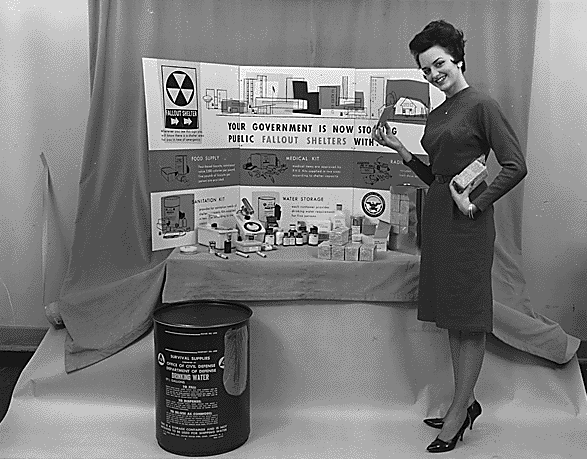
FalloutShelterSuppliesLarge.gif


Do you have enough larder to feed your family and some friends if grocery stores ran out of food? How about several assault rifles and a few thousand rounds of ammo? Solar panels, a water filter, medical kits, bug-out bags, fire starters, tents, sleeping bags, some junk silver and reserve gasoline?
Don?t worry, you?re not alone.

It?s becoming apparent to many Americans that depending on our local, state and federal governments in the event of an emergency, catastrophic societal collapse or widespread disaster will not be sufficient to meet the needs of your family. Residents in Colorado (and likely the other 49 states) are stockpiling in droves and preparing to live off the grid if it comes to that:
Four families in Yoder are building a sand bunker and stockpiling ammunition and weapons.​

A Black Forest resident has erected a geodesic dome on her 5-acre spread to grow vegetables, keeps horses for emergency transportation, in case she can?t get gasoline for her car, and plans to acquire chickens and goats as food sources.​

A husband and wife who have a cabin on 100 acres of secluded land in Park County have weaned their property from the electric grid, acquired a three-year food supply and taken other measures to become self-sufficient.​

While there?s little threat of the earthquake and tsumani that rocked Japan last month in landlocked Colorado, other epic crises on the home front are possible: A flood or fire. A terrorist attack. A nuclear weapons launch. World War III. Or an apocalyptic-type scenario.​

An increasing number of people say they are getting ready.​

?More people are getting into the survivalist mode. I?ve been in business 30 years, and I?ve never sold so many assault rifles as now. The last year was the best we?ve ever had,? said Mel Bernstein, a Class III weapons dealer and owner of Dragon Man?s shooting range east of Colorado Springs.​

Israeli gas masks, helmets and sand bags also have been selling well, he said.​

?People are putting stuff away in case something big happens,? he said. ?I think it?s superstition, but it?s been good for business.?​

Interest in the survivalist movement has been heightened, many say, by global turmoil.​

The ongoing strife in the Middle East, the lingering possibility that the Obama administration will enact stricter gun laws and the sustained economic downturn, coupled with political unrest in Libya and Japan?s nuclear catastrophe, have made people uneasy.​

In addition, doomsday prophesies by Nostradamus and the Mayans pinpointing 2012 are distressing for some. There?s also a group of Christians who say they?ve determined that the end of the world will begin on May 21.​

?People are afraid, and they want to be able to protect their families,? Bernstein said.​

Y2K ? the dawning of the third millennium ? brought forth a fury of survivalist instincts, as many believed the nation?s network of electric connections and computer systems would crash.​

The terrorist attacks of Sept. 11, 2001, raised concern among even the complacent.​

But this time in history feels more urgent, say those who identify themselves as ?preppers? ? people preparing to have all they need to sustain a catastrophe.​

?There?s a distinct possibility that some other country could wipe out our electronics and computers, and the U.S. infrastructure is not ready ? it would take six months to rebuild a transformer,? said Bob, a retired engineer who said he designed airplanes, power plants and aqueducts for the government.​

He asked that his last name not be used because he shares a philosophy common among preppers: the desire for anonymity. Not everyone understands why they?re doing what they?re doing, Bob said, and there?s the possibility of others looting their stockpiles.​

?Preppers will give someone a pound of rice and a bowl of soup, but we?ll defend ourselves against people who are going to take everything we have,? he said. ?We?re doing this to make sure that we can live the way we?ve been living and we?re not going to be out there scrounging or stealing food from others.?​
There are any number of scenarios, both natural and man-made, that could lead to what preppers refer to as TEOTWAWKI (The End of the World as We Know It), be it an electro magnetic pulse attack, a US dollar hyperinflation, economic collapse, an earthquake along the New Madrid Fault Line, Yellow Stone?s super volcano, or the purported Mayan end of days.
While some may be more likely to occur than others, and some are improbable outliers, the fact that the possibilities exist, and that there are a whole host of reasons why life as we have come to know it could be halted from one day to the next, makes preparedness that much more reasonable.
We?ve seen how governments respond to disasters. Recent history in the modern age suggests that there is simply no way to meet the needs of millions of people if a far-from-equilibrium situation were to arise.
Americans spend thousands of dollars per year on insurance for our homes, our cars, our health, our lives, and even our mortgages.
Is it really so crazy to insure ourselves from unforeseen black swans by stockpiling some food, water, supplies and a means to protect them?
The US government is spending billions of dollars to prepare for unlikely events like war, catastrophic collapse of society, and even asteroids ? maybe you should consider a little end-of-the-world insurance as well.
References: Colorado Springs Gazette, The Columbus Republic, Steve Quayle
 
Bet on MyBookie
Top