Pres. Obama always talks of having "inherited" a $1 trillion deficit. He campaigned against the free-spending ways of the last administration, promising a new era of responsibility.
How did he and his fellow Democrats in Congress respond once they took the reigns of power? But doubling down and immediately bloating the deficit to twice it's previous high.
I can understand folks making the argument that a significant economic/financial crisis requires a significant outlay of money to combat it. Tho I disagree with that, no economist or finance expert disagrees with the fact that the only responsible way to respond with "necessary" deficits in crisis years is to try and balance the budget once the economy is back on track in the good years.
Yet even the Obama Whitehouse is projecting large debts in the years after they say the economy will recover. And large as those projected debts, it's based on assuming the Obama Whitehouse's laughable strong growth projections come true, and their military spending will sharply decline due to less wars and nicer guys out there.
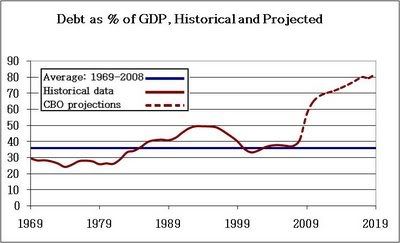
The independent Congressional Budget Office has put out a bit more realistic projections, charting the Obama debt vs GDP data, for the years when any responsible administration should be trying to balance the budget. It is very sobering:
These sort of facts Pres. Obama can't possibly defend, so he trashes his opponents: "I suspect that some of those Republican critics have a short memory, because as I recall I'm inheriting a $1.3 trillion deficit, annual deficit, from them." (I should note here that "annual deficit" Obama speaks of is the yearly gap between Federal Gov't spending out and taxes coming in. The "debt" is all the borrowing they have to do caused by all these past deficits).
And now Obama's Healthcare Bill will add $1 trillion to the budget over the next 10 years, sez the Congressional Budget Office (warning: PDF).
All this massive spending and debt, the greatest growth of government since that fine Texan Lyndon Johnson, will start to occur before many baby boomers retire (adding their vast off-balance-sheet liabilities in the Medicare and Social Security systems)
US debt was 41% of GDP in 1988, when Reagan left--the same as 2008 when Bush left. If those guys made mistakes, how does it make sense to bloat it all out to the 80% debt-to-GDP level projected when Obama leaves office after all his spending?
I can just envision the taxes coming! Bernanke has ruled out inflating the debt away, but Obama may replace him when his term expires.....

........................
update:
Obama being his slick self again. Like lotta clever folks, he's trying to talk his way around this (no action proposed yet) by now saying the right things. All which he knows is slurped up by his fawning press like lapdogs:
Obama frets on debt, sees U.S. unemployment rising
Reuters
Tuesday, June 16, 2009 5:50 PM
WASHINGTON (Reuters) - President Barack Obama said on Tuesday that worrying about the U.S. government's finances "keeps me awake at night" and the country needed to start planning now to tackle soaring deficits.
In a pair of interviews on CNBC and Bloomberg television, Obama defended increasing government spending to prevent the recession from worsening, and warned the unemployment rate may hit 10 percent this year, a level not seen since 1983.
"There's no doubt that we've got a serious problem in terms of our long-term deficits and debt," he told CNBC. "I make no apologies for having acted short term to deal with our recession."
But he said once the recession ends, "we're going to have to close that gap between the amount of money coming in and the amount of money going out."
The Congressional Budget Office estimated on Tuesday that the federal deficit would hit $1.43 trillion in fiscal 2010 under Obama's budget plan, slightly higher than it had previously forecast.
Obama said unless the United States can contain its long-term debt and deficits, foreign investors may shun U.S. assets, driving up borrowing costs for the government as well as households and businesses.
"I am concerned about the long-term issue of our structural deficit and our long-term debt because if we don't get a handle on that then there's no doubt that at some point whether it's the Chinese, the Koreans, the Japanese, whoever else has been snatching up Treasuries are going to decide that this is too much of a risk," he told Bloomberg.
How did he and his fellow Democrats in Congress respond once they took the reigns of power? But doubling down and immediately bloating the deficit to twice it's previous high.
I can understand folks making the argument that a significant economic/financial crisis requires a significant outlay of money to combat it. Tho I disagree with that, no economist or finance expert disagrees with the fact that the only responsible way to respond with "necessary" deficits in crisis years is to try and balance the budget once the economy is back on track in the good years.
Yet even the Obama Whitehouse is projecting large debts in the years after they say the economy will recover. And large as those projected debts, it's based on assuming the Obama Whitehouse's laughable strong growth projections come true, and their military spending will sharply decline due to less wars and nicer guys out there.
The independent Congressional Budget Office has put out a bit more realistic projections, charting the Obama debt vs GDP data, for the years when any responsible administration should be trying to balance the budget. It is very sobering:
These sort of facts Pres. Obama can't possibly defend, so he trashes his opponents: "I suspect that some of those Republican critics have a short memory, because as I recall I'm inheriting a $1.3 trillion deficit, annual deficit, from them." (I should note here that "annual deficit" Obama speaks of is the yearly gap between Federal Gov't spending out and taxes coming in. The "debt" is all the borrowing they have to do caused by all these past deficits).
And now Obama's Healthcare Bill will add $1 trillion to the budget over the next 10 years, sez the Congressional Budget Office (warning: PDF).
All this massive spending and debt, the greatest growth of government since that fine Texan Lyndon Johnson, will start to occur before many baby boomers retire (adding their vast off-balance-sheet liabilities in the Medicare and Social Security systems)
US debt was 41% of GDP in 1988, when Reagan left--the same as 2008 when Bush left. If those guys made mistakes, how does it make sense to bloat it all out to the 80% debt-to-GDP level projected when Obama leaves office after all his spending?
I can just envision the taxes coming! Bernanke has ruled out inflating the debt away, but Obama may replace him when his term expires.....
........................
update:
Obama being his slick self again. Like lotta clever folks, he's trying to talk his way around this (no action proposed yet) by now saying the right things. All which he knows is slurped up by his fawning press like lapdogs:
Obama frets on debt, sees U.S. unemployment rising
Reuters
Tuesday, June 16, 2009 5:50 PM
WASHINGTON (Reuters) - President Barack Obama said on Tuesday that worrying about the U.S. government's finances "keeps me awake at night" and the country needed to start planning now to tackle soaring deficits.
In a pair of interviews on CNBC and Bloomberg television, Obama defended increasing government spending to prevent the recession from worsening, and warned the unemployment rate may hit 10 percent this year, a level not seen since 1983.
"There's no doubt that we've got a serious problem in terms of our long-term deficits and debt," he told CNBC. "I make no apologies for having acted short term to deal with our recession."
But he said once the recession ends, "we're going to have to close that gap between the amount of money coming in and the amount of money going out."
The Congressional Budget Office estimated on Tuesday that the federal deficit would hit $1.43 trillion in fiscal 2010 under Obama's budget plan, slightly higher than it had previously forecast.
Obama said unless the United States can contain its long-term debt and deficits, foreign investors may shun U.S. assets, driving up borrowing costs for the government as well as households and businesses.
"I am concerned about the long-term issue of our structural deficit and our long-term debt because if we don't get a handle on that then there's no doubt that at some point whether it's the Chinese, the Koreans, the Japanese, whoever else has been snatching up Treasuries are going to decide that this is too much of a risk," he told Bloomberg.


 adlock: