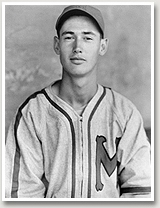
Ted Williams, the last major league player to hit .400 for an entire season, who was also Joe DiMaggio's arch rival, John Glenn's wing man, and Boston's preeminent athlete of the 20th century, died Friday.
He was 83.
Ted Williams is the last major leaguer hit .400 in a season.
Williams was the second-youngest player to ever lead the majors in runs batted in (only Ty Cobb was younger) and the oldest to win a batting title. He drove in 145 runs as a 21-year-old rookie in 1939 and was 40 in 1958 when he hit .328 for the last of his six American League batting championships. In a playing career that spanned four decades with the Red Sox and was interrupted by two military tours of duty that cost him nearly five full seasons, the 6-foot-3, 205-pound Splendid Splinter hit .344 with 521 home runs, 1,839 RBIs, 2,019 walks, a slugging percentage of .634 that remains second to only Babe Ruth's .690, and an on-base percentage of .483 that is second to no one.
"All I want out of life," Williams once told a friend, "is that when I walk down the street folks will say, 'There goes the greatest hitter that ever lived.' " In his 1969 autobiography, "My Turn at Bat," he added, "It was the center of my heart, hitting a baseball. (Boston general manager) Eddie Collins used to say I lived for my next at bat, and that's the way it was. If there was ever a man born to be a hitter it was me."
In 1941, The Kid hit .406 in just his third season in the big leagues, but his feat was overshadowed by DiMaggio's 56-game hitting streak which captivated the nation through mid-July. During the streak Williams was able to grab the spotlight away from Joe D for just one afternoon, the July 8th All-Star Game in Detroit. In the bottom of the ninth inning with two on and two out, the American League trailing by two runs, and a full house at Briggs Stadium clamoring for a three-run homer, Williams leaned into a belt-high fastball from Claude Passeau of the Chicago Cubs and drove the ball off the right field parapet to win the game. He would later call it, "the most thrilling hit of my career" and never was Teddy Ballgame more of a kid as he bounded around the bases, clapping his hands in childish glee.
Twelve weeks later, on September 28th, Williams delivered the most telling six hits of his career in a season-ending doubleheader at Shibe Park in Philadelphia. Unfazed by a 3-for-15 slump and not interested in going into the record books as a .400 hitter who actually hit .39955, Ted refused manager Joe Cronin's offer to sit out the twin bill. He then took the field and went 4-for-5 in the first game and 2-for-3 in the nightcap to finish the year at a more respectable .406. DiMaggio won the Most Valuable Player award in a close vote (291 points to 254), but the margin might have been thinner if the Yankees hadn't won the pennant by 17 games over the second place Sox. Nevertheless, the summer of '41 belonged to both players, as evidenced by the fact that in the 60 years since then no one has come within 12 games of Joe D's streak or 12 points of The Kid's average.
Unlike the imperturbable DiMaggio, who was the older of the two Californians by four years, Williams was given to tantrums when things didn't go his way. Joe said little to an adoring New York press and was revered. Ted said plenty to the less doting Boston scribes and was often reviled.
In 1940, after a sensational rookie year that saw him tip his cap regularly to appreciative crowds at Fenway Park, Williams' run production fell off despite the new bullpens in right field that moved the fences 23 feet closer to home plate. When some writers and fans started getting on him, Williams reacted by bad mouthing them right back. He complained about the criticism, groused about his salary, yearned to be traded, refused to tip his cap anymore at home, and after one frustrating game in Cleveland let off steam by whining: "Nuts to this baseball, I'd sooner be a fireman." If he was looking for sympathy from his teammates, he didn't get it. "Teddy is a spoiled boy," said Jimmie Foxx. "How long it will take him to grow up remains to be seen. But he'll have to grow up the hard way now." Led by antagonistic Boston Record columnist Dave Egan, who wrote that "Williams is the prize heel ever to wear a Boston uniform," the press landed on Williams with both feet.
"Between Ted and the Boston baseball writers there existed what was perhaps the most protracted and bitter athlete-writer feud of all time," said Fred Corcoran, the legendary golf promoter and Boston native who was also Williams' business manager. "When Ted came with the Sox there were no less than nine daily newspapers on Boston. The sportswriters, always fishing for an exclusive or scrambling for a fresh angle, would seize on any scrap of gossip or conjecture and blow it up into a headline. They fanned the flames of controversy without malice, but without rest, and they had no qualms about investigating an athlete's private life if it sold newspapers. Turn this crew loose on a guy like Williams, who stubbornly insisted on his right to privacy, and you had all the elements of a political battle."
The mutual loathing didn't seem to affect Williams hitting in 1941 or the following year when he won his first Triple Crown by leading the majors in batting, home runs, and RBIs. But it probably cost him the 1942 MVP award which the baseball writers gave to Yankee second baseman Joe Gordon by a 21-point margin. Gordon had a career year and New York finished nine games ahead of Boston, but his offensive numbers paled next to those of Williams.
During the '42 season, the first since the Japanese attack on Pearl Harbor brought the United States into World War II, some writers accused Ted of dodging the draft when he refused to give up his exempt III-A status as sole provider for his mother. Hardly any of baseball's front line talent enlisted during that season, but Williams got most of the heat because he got hottest under the collar about it.
Yet Williams turned out to be baseball's longest-serving military warrior, missing three full seasons (1943-45) during World War II and most of the 1952 and '53 seasons when the Korean War was going on. Trained as a Navy fighter pilot and slated for combat in the South Pacific in '45, Japan surrendered before he could see action. Seven years later, at age 33, his reserve unit was recalled to active duty with the Marines and he flew 39 missions over the Korean mainland.
On Feb. 19, 1953, flying low on a bombing run far above the 38th parallel, Williams' F-9 Panther was hit by small arms fire and started leaking hydraulic fluid. With his plane shaking badly (he didn't know it was also on fire), his control panel lit up with warning lights, and his radio dead, Williams followed a fellow pilot back to base, flying without hydraulics and wrestling his stick all the way. Approaching the landing field, an on-board explosion blew off one of the wheel doors and Williams was forced to land his crippled jet at 225 miles-an-hour and on one wheel. When the F-9 finally came to a stop at the end of the runway after skidding over 2,000 feet, Williams walked away from the burning wreck as firemen hosed it down with foam. Fortunate but enraged, he reacted to nearly auguring in as if he had just popped out with the bases loaded in the bottom of the ninth -- he yanked off his helmet and slammed it to the ground.
"Ted Williams was what John Wayne would have liked us to think he was," said sportswriter Robert Lipsyte. "Williams was so big, and handsome, and laconic, and direct, and unafraid in that uniquely American cowboy way. To me he epitomized the sense of the athlete as gunslinger."
Williams flew combat missions for the Marines in the Korean War.
Tom Wolfe, in his book on the early years of the United States space program, called that singular quality "the right stuff." For much of his tour in Korea, Williams flew along side his operations officer, a five-time Distinguished Flying Cross winner named John Glenn, who would later become one of the seven original Mercury astronauts and the first American to orbit the earth.
"We flew together quite a lot and got to know each other very well," said Glenn. "Ted was an excellent pilot, and not shy about getting in there and mixing it up."
"For the last half of their flights together, Williams was Glenn's wingman," said biographer Ed Linn. "You don't pick a wingman because he can hit a baseball. You pick him because he can save your life."
Theodore Samuel Williams was born on Aug. 8, 1918, in San Diego, the oldest of two brothers. His parents were not close, to each other or their sons. His mother was a dedicated soldier in the Salvation Army and her religious calling came first. With his folks away from home a lot, Ted grew up playing baseball at the North Park playground near home and then the diamond at Herbert Hoover High School. He also developed a talent for fishing on frequent trips to Coronado Beach with neighbor Les Cassie, whose sons didn't like to fish.
A star pitcher and outfielder at Hoover High, young Ted might have signed with the New York Yankees in 1936 if his mother hadn't refused to endorse the contract. She did, however, let him play for the new San Diego Padres team in the Pacific Coast League for $150 a month. A year later, after batting .349 in his second season with the Padres and homering in all eight PCL ballparks, the Red Sox signed Williams for $25,000 and sent him to Minneapolis. His one and only year in the American Association in 1938, the intimidating if immature 20-year-old slugger won the Double A Triple crown, batting .366 with 43 home runs and 142 RBIs. Boston brought him up in 1939.
He was 83.
Ted Williams is the last major leaguer hit .400 in a season.
Williams was the second-youngest player to ever lead the majors in runs batted in (only Ty Cobb was younger) and the oldest to win a batting title. He drove in 145 runs as a 21-year-old rookie in 1939 and was 40 in 1958 when he hit .328 for the last of his six American League batting championships. In a playing career that spanned four decades with the Red Sox and was interrupted by two military tours of duty that cost him nearly five full seasons, the 6-foot-3, 205-pound Splendid Splinter hit .344 with 521 home runs, 1,839 RBIs, 2,019 walks, a slugging percentage of .634 that remains second to only Babe Ruth's .690, and an on-base percentage of .483 that is second to no one.
"All I want out of life," Williams once told a friend, "is that when I walk down the street folks will say, 'There goes the greatest hitter that ever lived.' " In his 1969 autobiography, "My Turn at Bat," he added, "It was the center of my heart, hitting a baseball. (Boston general manager) Eddie Collins used to say I lived for my next at bat, and that's the way it was. If there was ever a man born to be a hitter it was me."
In 1941, The Kid hit .406 in just his third season in the big leagues, but his feat was overshadowed by DiMaggio's 56-game hitting streak which captivated the nation through mid-July. During the streak Williams was able to grab the spotlight away from Joe D for just one afternoon, the July 8th All-Star Game in Detroit. In the bottom of the ninth inning with two on and two out, the American League trailing by two runs, and a full house at Briggs Stadium clamoring for a three-run homer, Williams leaned into a belt-high fastball from Claude Passeau of the Chicago Cubs and drove the ball off the right field parapet to win the game. He would later call it, "the most thrilling hit of my career" and never was Teddy Ballgame more of a kid as he bounded around the bases, clapping his hands in childish glee.
Twelve weeks later, on September 28th, Williams delivered the most telling six hits of his career in a season-ending doubleheader at Shibe Park in Philadelphia. Unfazed by a 3-for-15 slump and not interested in going into the record books as a .400 hitter who actually hit .39955, Ted refused manager Joe Cronin's offer to sit out the twin bill. He then took the field and went 4-for-5 in the first game and 2-for-3 in the nightcap to finish the year at a more respectable .406. DiMaggio won the Most Valuable Player award in a close vote (291 points to 254), but the margin might have been thinner if the Yankees hadn't won the pennant by 17 games over the second place Sox. Nevertheless, the summer of '41 belonged to both players, as evidenced by the fact that in the 60 years since then no one has come within 12 games of Joe D's streak or 12 points of The Kid's average.
Unlike the imperturbable DiMaggio, who was the older of the two Californians by four years, Williams was given to tantrums when things didn't go his way. Joe said little to an adoring New York press and was revered. Ted said plenty to the less doting Boston scribes and was often reviled.
In 1940, after a sensational rookie year that saw him tip his cap regularly to appreciative crowds at Fenway Park, Williams' run production fell off despite the new bullpens in right field that moved the fences 23 feet closer to home plate. When some writers and fans started getting on him, Williams reacted by bad mouthing them right back. He complained about the criticism, groused about his salary, yearned to be traded, refused to tip his cap anymore at home, and after one frustrating game in Cleveland let off steam by whining: "Nuts to this baseball, I'd sooner be a fireman." If he was looking for sympathy from his teammates, he didn't get it. "Teddy is a spoiled boy," said Jimmie Foxx. "How long it will take him to grow up remains to be seen. But he'll have to grow up the hard way now." Led by antagonistic Boston Record columnist Dave Egan, who wrote that "Williams is the prize heel ever to wear a Boston uniform," the press landed on Williams with both feet.
"Between Ted and the Boston baseball writers there existed what was perhaps the most protracted and bitter athlete-writer feud of all time," said Fred Corcoran, the legendary golf promoter and Boston native who was also Williams' business manager. "When Ted came with the Sox there were no less than nine daily newspapers on Boston. The sportswriters, always fishing for an exclusive or scrambling for a fresh angle, would seize on any scrap of gossip or conjecture and blow it up into a headline. They fanned the flames of controversy without malice, but without rest, and they had no qualms about investigating an athlete's private life if it sold newspapers. Turn this crew loose on a guy like Williams, who stubbornly insisted on his right to privacy, and you had all the elements of a political battle."
The mutual loathing didn't seem to affect Williams hitting in 1941 or the following year when he won his first Triple Crown by leading the majors in batting, home runs, and RBIs. But it probably cost him the 1942 MVP award which the baseball writers gave to Yankee second baseman Joe Gordon by a 21-point margin. Gordon had a career year and New York finished nine games ahead of Boston, but his offensive numbers paled next to those of Williams.
During the '42 season, the first since the Japanese attack on Pearl Harbor brought the United States into World War II, some writers accused Ted of dodging the draft when he refused to give up his exempt III-A status as sole provider for his mother. Hardly any of baseball's front line talent enlisted during that season, but Williams got most of the heat because he got hottest under the collar about it.
Yet Williams turned out to be baseball's longest-serving military warrior, missing three full seasons (1943-45) during World War II and most of the 1952 and '53 seasons when the Korean War was going on. Trained as a Navy fighter pilot and slated for combat in the South Pacific in '45, Japan surrendered before he could see action. Seven years later, at age 33, his reserve unit was recalled to active duty with the Marines and he flew 39 missions over the Korean mainland.
On Feb. 19, 1953, flying low on a bombing run far above the 38th parallel, Williams' F-9 Panther was hit by small arms fire and started leaking hydraulic fluid. With his plane shaking badly (he didn't know it was also on fire), his control panel lit up with warning lights, and his radio dead, Williams followed a fellow pilot back to base, flying without hydraulics and wrestling his stick all the way. Approaching the landing field, an on-board explosion blew off one of the wheel doors and Williams was forced to land his crippled jet at 225 miles-an-hour and on one wheel. When the F-9 finally came to a stop at the end of the runway after skidding over 2,000 feet, Williams walked away from the burning wreck as firemen hosed it down with foam. Fortunate but enraged, he reacted to nearly auguring in as if he had just popped out with the bases loaded in the bottom of the ninth -- he yanked off his helmet and slammed it to the ground.
"Ted Williams was what John Wayne would have liked us to think he was," said sportswriter Robert Lipsyte. "Williams was so big, and handsome, and laconic, and direct, and unafraid in that uniquely American cowboy way. To me he epitomized the sense of the athlete as gunslinger."
Williams flew combat missions for the Marines in the Korean War.
Tom Wolfe, in his book on the early years of the United States space program, called that singular quality "the right stuff." For much of his tour in Korea, Williams flew along side his operations officer, a five-time Distinguished Flying Cross winner named John Glenn, who would later become one of the seven original Mercury astronauts and the first American to orbit the earth.
"We flew together quite a lot and got to know each other very well," said Glenn. "Ted was an excellent pilot, and not shy about getting in there and mixing it up."
"For the last half of their flights together, Williams was Glenn's wingman," said biographer Ed Linn. "You don't pick a wingman because he can hit a baseball. You pick him because he can save your life."
Theodore Samuel Williams was born on Aug. 8, 1918, in San Diego, the oldest of two brothers. His parents were not close, to each other or their sons. His mother was a dedicated soldier in the Salvation Army and her religious calling came first. With his folks away from home a lot, Ted grew up playing baseball at the North Park playground near home and then the diamond at Herbert Hoover High School. He also developed a talent for fishing on frequent trips to Coronado Beach with neighbor Les Cassie, whose sons didn't like to fish.
A star pitcher and outfielder at Hoover High, young Ted might have signed with the New York Yankees in 1936 if his mother hadn't refused to endorse the contract. She did, however, let him play for the new San Diego Padres team in the Pacific Coast League for $150 a month. A year later, after batting .349 in his second season with the Padres and homering in all eight PCL ballparks, the Red Sox signed Williams for $25,000 and sent him to Minneapolis. His one and only year in the American Association in 1938, the intimidating if immature 20-year-old slugger won the Double A Triple crown, batting .366 with 43 home runs and 142 RBIs. Boston brought him up in 1939.