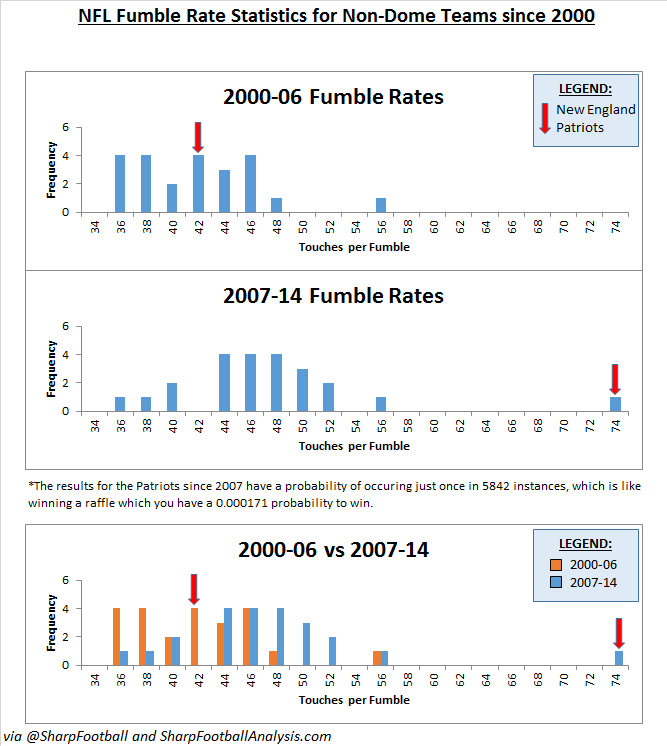
Just very interesting stuff on the Pats success in bad weather, fumbling rates, players fumbling more on other teams, etc.
Jack/IE - I wasn't sure if you wanted me posting a link, so I just cut and pasted... I can provide the link so the charts will show up (for those that don't read so well, or have a bad case of ADD)
Stats Show the New England Patriots Became Nearly Fumble-Proof after 2006 Rule Change Proposed by Tom Brady
Posted on January 26, 2015
By Warren Sharp
While speculation exists that ?Deflate Gate? was a one time occurrence, data I introduced last week indicated that the phenomena MAY have been an ongoing, long standing issue for the New England Patriots. Today, that possibility looks as clear as day.
Initially, looking at weather data, I noticed the Patriots performed extremely well in the rain, much more so than they were projected. I followed that up by looking at the fumble data, which showed regardless of weather or site, the Patriots prevention of fumbles was nearly impossible. Ironically, both studies saw the same exact starting point: 2007 was the first season where things really changed for the Patriots. Something started in 2007 which is still on-going today.
I wanted to compare the New England Patriots fumble rate from 2000, when HC Bill Belichick first arrived in New England, to the rest of the NFL. Clearly, one thing I found in my prior research was that dome teams fumble substantially less frequently, given they play at least 8+ games out of the elements each year. To keep every team on a more level playing field, I eliminated dome teams from the analysis, grabbed only regular season games, and defined plays as pass attempts+rushes+times sacked. The below results also look only at total fumbles, not just fumbles which are lost. This brought us to the ability to capture touches per fumble.
To really confirm something was dramatically different in New England, starting in 2007 thru present, I compared the 2000-06 time period (when Bill Belichick was their head coach and they won all of their Super Bowls) to the 2007-2014 time period. The beauty of data is the results speak for themselves:
(click to enlarge)
The data is jaw dropping, and this visual perfectly depicts what happened. From a more technical perspective, John Candido, a Data Scientist at ZestFinance who is a colleague of mine over at the NFLproject.com website and was also involved in the development of this research, comments:
Based on the assumption that plays per fumble follow a normal distribution, you?d expect to see, according to random fluctuation, the results that the Patriots have gotten since 2007 once in 5842 instances.
Which in layman?s terms means that this result only being a coincidence, is like winning a raffle where you have a 0.0001711874 probability to win. In other words, it?s very unlikely that results this abnormal are only due to the endogenous nature of the game.
Many of the arguments giving the Patriots the benefit of the doubt are evaporating. While this data does not prove they deflated footballs starting in 2007, we know they were interested in obtaining that ability in 2006. (This is something I found out AFTER I performed the first two analyses, both of which independently found that something changed starting in 2007.)
In 2006, Tom Brady (and Peyton Manning) lobbied in favor of changing a NFL rule, and as a result, the NFL agreed to change policies. Brady wanted the NFL to let EVERY team provide its OWN footballs to use on offense, even when that team was playing on the road. Prior to that year, the HOME team provided ALL the footballs, meaning the home quarterback selected the footballs the ROAD quarterback would play with on offense.
Brady?s quote at the time, when pushing for the change was: ?The thing is, every quarterback likes it a little bit different. Some like them blown up a little bit more, some like them a little more thin, some like them a little more new, some like them really broken in.?
Obviously this information, when combined with the data above, is exceedingly compelling. Not only can you visually see the change when aggregating the data into periods of 2000-06 and 2007-14, you can clearly see how it occurs on the following two graphs. The data is the same, but details are added in the second graph to provide additional information and context:
(click to enlarge)
Once again, a key takeaway is deadly obvious: prior to 2007 the Patriots were RIGHT IN LINE with the league averages across the other non-dome teams. When you look team by team, they literally are in the middle of the pack for most seasons, as the histogram in the very first graphic at the top of this article shows. But starting in 2007, all similarities totally vanish.
The statistical ?jump? the Patriots make in the 2006 offseason, from one fumble every 39 plays to one fumble every 76 plays is nothing short of remarkable. Their trendline over this period is not even close to that of the rest of the NFL.
The 2013 season is an oddity in that the Patriots were actually slightly worse than the rest of the NFL. Looking at that season, its apparent the reason: of the Patriots 23 fumbles that season, 6 (over 25%) occurred in a Sunday night game vs the Broncos played in 22 degree weather, with 22 mph winds and a wind chill of 6 degrees. Cold conditions of this nature absolutely cause more fumbles than usual. They fumbled a TOTAL of 5 times in 11 of their 16 games in 2013 (69% of their total games), so it truly was this week 12 ?antarctic? game (and a week 17 game vs the Bills which saw 4 fumbles) which really put the Patriots fumble rates for 2013 out of sync. This is exactly why looking at small sample sets, such as single seasons, is not the preferred manner to investigate this analysis.
Why are fumbles so important? Because as Bill Belichick knows, perhaps more so than most NFL coaches due to his understanding of the game ? turnovers usually control game outcomes. Since 2000, teams who won the turnover battle won 79% of their games, regardless of ANY other statistic. A 12-5 record equates to 75% wins, so its clear how vital turnovers are in the minds of intelligent coaches. And as far as turnovers are concerned, the number one concern for a team with a quarterback as skilled and proficient as Tom Brady is not interceptions (because there won?t be many), its fumbles.
There are many arguments which have been raised in favor of why the Patriots don?t fumble as often as other teams. Many of them are simply factually incorrect. If it was coaching, former players should be able to tell us that Bill Belichick suddenly and drastically changed the way he instructed players to carry the football in the 2006 offseason. But the data shows that if mysterious trade secret was delivered, the players forgot about it when they left New England, as their individual fumble rates became drastically worse when playing for other NFL teams.
The bottom line is, something happened in New England. It happened just before the 2007 season, and it completely changed this team. While NFL teams apparently are complaining to the league that they felt the Patriots played with deflated footballs during the 2014 season and postseason, all investigations into those allegations would be wise to reference my research herein, and begin the investigation in the 2006. That was when Tom Brady was able to persuade the NFL to change its rules to allow him (and other quarterbacks) to provide their own footballs for all road games. I will reiterate, this analysis cannot say it was, undoubtedly, illegal football deflation which caused the data abnormalities. But it does conclude that something absolutely changed, and it was not the result of simple random fluctuation.
__________________________
Because I was asked so often for the data that I used in the first analysis, as a courtesy, I am going to link an excel file with all the summary data used to create the graphics shown above. Support Data
Warren Sharp of *************** is an industry pioneer at the forefront of incorporating advanced analytics and metrics into football analysis. A licensed Professional Engineer by trade, Warren applies the same critical thought process and problem solving techniques into his passion, football. After spending years constructing, testing and perfecting computer models written to understand the critical elements to win NFL football games, Warren?s quantitative analytics are used in private consulting work, and elements of which are publicly shared on sharpfootballanalysis.com. To contact Warren, please email sharp@sharpfootballanalysis.com or send a direct message on Twitter to @SharpFootball.
Posted in Uncategorized
New England Patriots Fumble More Often When Playing for Other Teams
Posted on January 25, 2015
By Warren Sharp
Last Thursday?s groundbreaking article on the impossibly real fumble prevention statistics by the New England Patriots was certainly a perfect lesson on the power of social media and sending a critical story ?viral?. I tried to take a very unassuming, impartial look into a highly controversial topic, based not on opinion, but on statistics. What caught the attention of many was that it was uniquely different from the other ?theory based? pieces on this topic, and contained undeniable concrete evidence that whatever was happening in New England since 2007 was more than just ridiculously abnormal. It was absolutely not a random fluctuation in the data and was extremely unlikely to be a mere coincidence.
After watching primetime TV and some of the Sunday morning national news shows, in addition to the Bill Belichick press conference from Saturday, it is clear that many in the media still believe this story is about a single-game incident. And because that particular game was not close on the score board, the issue of ball inflation is not a concern. I cannot deny the fact that I too was skeptical of this issue to begin with, and initially believed it to be immaterial ? just another irrelevant story being hyped to create ratings. Which is why I decided to investigate myself, and let the data show any abnormalities, should they exist.
The problem with dismissing this as an immaterial, single-game incident is that it ignores reality. It ignores the abundance of data which shows a massive anonomly exists in New England which potentially could be tied back to the crux of this investigation: proper ball inflation (or lack thereof). Belichick spent an inordinate amount of time discussing a ?simulation? they performed of their game day football preparation operation. Regardless of what they specifically do to the footballs, it certainly would be remarkable if their techniques are so vastly different from the other 31 teams that only the Patriots footballs see a drop of 2 psi while all other teams remain in the legal range. But as the data appears to indicate, since 2007, the footballs that the Patriots use on offense (or something else the Patriots do offensively) are completely dissimilar to the other 31 teams. Not just by a slight margin, but so massively that it is an injustice to possibly cite the persistent, obvious variance over 8 years could be attributed to ?climatic conditions?, ?atmospheric conditions?, a ?rubbing process?, or an ?equilibrium getting reached?.
There were many follow-up thoughts and questions raised by the masses who gravitated to the piece across not just the United States, but from around the world. In a way, it was a great example of how international the NFL has become. Hundreds of thousands people are interested in this story and concerned about the findings I presented. Certainly, the NFL is justified in spending ample time to research as much as they can to determine the full extent of the situation. But more than encouraged by the sheer volume (which crashed multiple servers along the way), the reaction to the initial study was an affirmation of the power of data analysis and statistics. The appreciation for crunching vast amounts of data to obtain a very simple, specific and precise conclusion which is unadulterated by a loud, distracting voice was clearly evidenced by how willing, enthusiastically and expeditiously the story was shared. The feedback was tremendous, but of all the questions raised, the one most frequently asked (by literally hundreds of people) was: ?What if you take a look at individual players when playing for the Patriots and when playing on other teams? How does the data change, and what would it tell us?? It was a terrific suggestion.
So I ran the analysis. I?ll immediately share the results below, before diving into exactly how we arrive at these conclusions:
Patriots players fumbled SIGNIFICANTLY more often when playing on other NFL teams than when playing for the Patriots:
Individual players who played on New England during the 2007-14 span and on other teams fumbled 46% less often ON the Patriots as compared to on their other teams (98 touches/fumble on NE, 67 on other teams).
The most utilized of the Patriots players fumbled even more frequently when paying for other NFL teams:
The players who played the MOST often for the Patriots during this span fumbled the ball TWICE as frequently on other teams as they did on the Patriots (107 touches/fumble on NE, 53 on other teams).
Learning ball possession skills in New England did NOT transfer to other NFL teams after players left:
Individual players who played on the Patriots fumbled 88% more often after LEAVING the Patriots as they did when playing on the Patriots (105 touches/fumble on NE, 56 after NE on other teams).
In fact, the opposite was true ? players were MORE secure carrying the football before even playing for the Patriots than they were after leaving the Patriots:
Individual players who played on the Patriots fumbled 25% less frequently before joining New England as they did after playing for New England and then leaving (70 touches/fumble before NE, 56 after NE).
Methodology. I attacked this study it as I always try to do: logically, impartially and always looking for ?something more? even after finding data which offers a strong conclusion. I looked at all player statistics for the Patriots between 2007-2014. I started in 2007 because it appears from both my initial ?fumble? analysis as well as my ?weather? analysis that things suddenly changed in 2007 when looking at long term Patriots data. The 2007 season is when they skyrocket into the realm of other-worldly, where they stand alone from any team in NFL history.
Quick sidebar: Without even knowing what happened in 2007, I can tell from the data something changed for New England which did not change for the other 31 NFL teams. But the stars apparently are aligning on a NFL rule change which Tom Brady (and Peyton Manning) lobbied in favor of, and the NFL agreed to change policies. Brady wanted the NFL to let EVERY team provide its OWN footballs to use on offense. Prior to that year, the HOME team provided ALL the footballs, meaning the home quarterback selected the footballs the ROAD quarterback would play with on offense.
Brady?s quote at the time, when pushing for the change was: ?The thing is, every quarterback likes it a little bit different. Some like them blown up a little bit more, some like them a little more thin, some like them a little more new, some like them really broken in.?
Regardless of exactly what started to happen in New England in 2007, the Patriots offense fumbled significantly less often, which is why I looked at their individual player data beginning in 2007.
Comparing the individual Patriots offensive players statistics against statistics for those same exact players when they played on other teams certainly is compelling, as the table below illustrates:
(click to enlarge)
As a whole, these players fumbled once every 98 plays when donning a Patriots uniform, but once every 67 plays when playing for any other NFL team. That is a 46% improvement when they played for New England from 2007 thru 2014.
Clearly there are many players at the bottom of the list (which is sorted by total touches when playing for New England) who carried the ball very infrequently (and never fumbled). To eliminate some of the noise created by these less utilized players, I decided to take a subset of data which looked ONLY at players with over 300 touches as a Patriot from 2007-2014 who also played on other teams before or after. They are the 5 players at the top of the list.
As the chart above indicates, these players fumbled once per 107 touches in New England, but once very 53 touches when playing on another team. That is an improvement of OVER 100%!
Obviously, that data is shocking. These same individuals fumbled twice as often when playing for other teams. When trying to explain the Patriots refusal to fumble, we no longer have the argument: ?maybe the Patriots draft/acquire players who don?t fumble.? We are now at the point where we can say these individuals, for some reason, fumbled TWICE AS OFTEN on other teams as they did in New England.
The next logical question would be: ?What about players who LEFT the Patriots and THEN played for other teams? Maybe these players learned a ball protection skill or a special secret trick while IN NEW ENGLAND to reduce their fumbles. Surely they would take this with them elsewhere and their numbers AFTER leaving the Patriots would be good.?
So I performed that analysis. I looked ONLY at players who left New England at some point after 2007, and I grabbed only their stats when playing for other teams AFTER playing in New England. The caution here is we are slowly decreasing the data size, and thus adding variance into the numbers. The chart is below:
(click to enlarge)
As you can see, these players fumbled once every 105 touches in New England, which is similar to the numbers we saw above, and is not surprising. But when playing for other teams, they fumbled once every 56 touches! That?s an 88% increase. And it comes AFTER they recorded incredible numbers for the Patriots.
When trying to explain why the Patriots refuse to fumble, we no longer have the argument: ?there is a secret manner in which to hold the football or special coaching techniques which get entrusted to the Patriots during this 2007-14 time frame.? These very same individuals, after leaving New England, see their fumbles/touch increase at an alarming rate.
Obviously Brandon Tate stands out in this analysis. But the only players of these 10 to fumble LESS frequently after playing for the Patriots were Wes Welker and Ben Watson. All of the other 8 players on this list fumbled MORE FREQUENTLY after playing for the Patriots.
Those of you paying close attention also likely noticed one final, remarkable takeaway from this analysis:
The entire collection of total players in this study actually fumbled LESS frequently BEFORE joining the Patriots as compared to when they left the Patriots. That flies in the face of the thought that ?fumblers? joined the Patriots, were straightened out, and then left as reformed ball controllers. The first two lines on this next chart are pulled directly from the top two charts, and the third line is the difference:
(click to enlarge)
It is clear by these numbers, that these 18 players who qualified for this analysis fumbled once every 70 touches before joining the Patriots and once every 56 touches after leaving the Patriots.
When trying to explain why the Patriots refuse to fumble, we no longer have the argument: ?the Patriots took fumble prone players, taught them better techniques while in New England to improve their ball possession, and they left better than when they were brought in.? These players were actually 25% BETTER at securing the football before they ever even worked with the Patriots than they were after playing in New England and then joining another team!
There clearly are a number of takeaways to sum up this portion of analysis, and to restate them from the top of this article:
Patriots players fumbled SIGNIFICANTLY more often when playing on other NFL teams than when playing for the Patriots:
Individual players who played on New England during the 2007-14 span and on other teams fumbled 46% less often ON the Patriots as compared to on their other teams (98 touches/fumble on NE, 67 on other teams).
The most utilized of the Patriots players fumbled even more frequently when paying for other NFL teams:
The players who played the MOST often for the Patriots during this span fumbled the ball TWICE as frequently on other teams as they did on the Patriots (107 touches/fumble on NE, 53 on other teams).
Learning ball possession skills in New England did NOT transfer to other NFL teams after players left:
Individual players who played on the Patriots fumbled 88% more often after LEAVING the Patriots as they did when playing on the Patriots (105 touches/fumble on NE, 56 after NE on other teams).
In fact, the opposite was true ? players were MORE secure carrying the football before even playing for the Patriots than they were after leaving the Patriots:
Individual players who played on the Patriots fumbled 25% less frequently before joining New England as they did after playing for New England and then leaving (70 touches/fumble before NE, 56 after NE).
Quick sidebar #2: Another argument which is frequently made in defense of the Patriots abnormal fumble rate: ?Bill Belichick emphasizes possessing the football and cuts players who fumble.? First, let me say its absurd to assume that other NFL coaches are ?fine? with a player who fumbles frequently, and only Bill Belichick stresses reducing turnovers. But even if we believe only Belichick cares, and he abnormally and quickly hooks any player guilty of this enormous transgression, let?s look at a few players on his team now and historically:
In 2013, WR Julian Edelman fumbled 6 times. No non-QB for Bill Belichick ever fumbled more in one season. Yet Edelman is the key WR still playing for New England. In fact, Edelman followed that up with 5 fumbles this season (and twice more in the playoffs). In total, 5 of these fumbles came on offense (not returning kicks). But we don?t hear any discussion of benching Edelman for the Super Bowl. In fact, Edelman?s fumble rate was one fumble every 18 touches in 2013 and one every 20 this year! If you look at the numbers above, you will see how terrible those numbers are for a Patriot. No receiver with 50+ catches under Belichick has ever fumbled more frequently than Edelman did this season.
RB Stevan Ridley is the poster boy of the ?fumbler? for the Patriots, who fumbled 8 times between 2012 and 2013. But his fumble rate was still only one fumble per 61 touches. In 2013, he improved his fumble rate from once every 47 touches to once every 74 touches, a significant improvement of 57%. Compare Ridley to one of Belichick?s most beloved players, Kevin Faulk, and you will see Faulk?s fumble rate was worse:
In 2005 RB Kevin Faulk fumbled a total of 3 times despite having only 80 offensive touches (he only returned 4 total kicks that year). That rate of one fumble per 27 touches is obviously more than twice as bad as Ridley?s two-year average and almost 3 times worse than Ridley?s 2013 season. Yet Faulk played his entire career for the Patriots, all the way thru until 2011, and is widely considered one of the Patriots most valuable offensive assets over that time.
In 2004, the Patriots acquired RB Corey Dillon from the Bengals. Dillon recorded 5 fumbles on 360 touches, a rate of one fumble per 72 touches. That rate was worse than Ridley?s 2013 season. In fact, it was the worst fumble rate for any Patriot under Bill Belichick who had at least 200 rushes. Yet Dillon finished his career 3 years later in 2006, still with the Patriots.
In 2013, RB LeGarrette Blount fumbled 3 times on 155 touches for the Patriots. That was a rate of 1 fumble every 52 touches. Very similar to the 2013 fumble rate of Ridley (once every 47 touches). Yet Belichick brought Blount back to the Patriots in the middle of this season after he was cut from the Pittsburgh Steelers, and is now the starting RB for the Patriots in next week?s Super Bowl. That is despite Blount having the 3rd worst fumble rate of any Patriots RB under Belichick with at least 100 carries in a season.
In 2006, TE Ben Watson had 49 touches and 3 fumbles, a terrible rate of 16 touches per fumble. It was the worst fumble rate of any receiver under Belichick with over 10 receptions. Yet Belichick kept Watson in New England for the next 3 seasons, where he played in 42 of the 48 regular season games, starting in well over half the games.
Despite fumbling once every 24 touches (an extremely bad rate) in 2008, WR Randy Moss caught 20% more passes for the Patriots in 2009.
Certainly Bill Belichick places emphasis on ball possession, as does every NFL head coach. And more goes into decisions on who to keep, play and start than just fumbles. Anecdotally it does seem like Belichick pulls players quickly who fumble often, but the fact is, if you look at the data, he treats other players who have similar (or worse) fumble rates differently. Ultimately, its likely about the total package the player provides for Belichick rather than simply his fumble-aversion statistic alone. This far less technical case study certainly appears to show that there is no set ?limit? to the tolerance Bill Belichick has for fumbles from his players. So I think we can dismiss the defense that ?Bill Belichick yanks players who fumble often, and then cuts them.? While he may do that to certain players, clearly it is not a consistent position he has taken historically across-the-board with all players, many of which are mentioned above.
Once again, we are left with highly compelling evidence which certainly refutes a number of arguments made in defense of the statistical anomaly that is the New England Patriots from 2007-2014. While the data cannot tell us precisely WHAT the Patriots were doing to prevent fumbles, keep in mind, the data was the foremost clue that something was occurring, and told us precisely WHEN it began (all of which I introduced in my article last Thursday). The additional data compiled from this latest research project is now beginning to shed light on what the Patriots were NOT doing to prevent fumbles. To prevent fumbles for the New England Patriots: they were not amassing a collection of highly fumble-adverse players. They were not teaching a special ball-carrying technique which was entrusted to their players. And they were not targeting fumble-prone players and reforming them in New England to permanently cure them of their bad fumbling habits.
_______________________________________________________________
Warren Sharp of sharpfootballanalysis.com is an industry pioneer at the forefront of incorporating advanced analytics and metrics into football analysis. A licensed Professional Engineer by trade, Warren applies the same critical thought process and problem solving techniques into his passion, football. After spending years constructing, testing and perfecting computer models written to understand the critical elements to win NFL football games, Warren?s quantitative analytics are used in private consulting work, and elements of which are publicly shared on ********. To contact Warren, please email [emai***************or send a direct message on Twitter to *********
Posted in Uncategorized
The New England Patriots Prevention of Fumbles is Nearly Impossible
Posted on January 22, 2015
By Warren Sharp
After reading this piece, be sure to review the follow-up article, which looks at individual player data for New England Patriots when playing on other NFL teams.
QUICK NOTE: The analysis at the TOP looks at fumbles LOST. Further down, I look at ALL fumbles, regardless of who recovered.
Yesterday I investigated whether or not the New England Patriots outperform expectations in bad weather. I had several recommendations to look at home and road data, as opposed to just home data. Mulling whether or not to undertake that further (time consuming) analysis, I watched this video:
I immediately noticed something that cannot be overlooked: the issue with ball security and fumbles. Then I remembered this remarkable fact:
The 2014 Patriots were just the 3rd team in the last 25 years to never have lost a fumble at home! The biggest difference between the Patriots and the other 2 teams who did it was that New England ran between 150 and 200 MORE plays this year than those teams did in the years they had zero home fumbles, making the Patriots stand alone in this unique statistic.
Based on the desire to incorporate full season data (not just home games, as a team theoretically bring ?doctored footballs? with them on the road) I performed the following analysis:
I looked at the last 5 years of data (since 2010) and examined TOTAL FUMBLES in all games (as well as fumbles/game) but more importantly, TOTAL OFFENSIVE PLAYS RUN. Thus, we can to determine average PLAYS per FUMBLE, a much more valuable statistic. The results are displayed in the chart below. Keep in mind, this is for all games since 2010, regardless of indoors, outdoors, weather, site, etc. EVERYTHING.
(click to enlarge)
One can CLEARLY SEE the Patriots, visually, are off the chart. There is no other team even close to being near to their rate of 187 offensive plays (passes+rushes+sacks) per fumble. The league average is 105 plays/fumble. Most teams are within 21 plays of that number.
I spoke with John Candido, a Data Scientist at ZestFinance who I know from work on the NFLproject.com website, and sent him the data. He said:
Based on the assumption that fumbles per play follow a normal distribution, you?d expect to see, according to random fluctuation, the results that the Patriots have gotten over this period, once in 16,233.77 instances?.
Which in layman?s terms means that this result only being a coincidence, is like winning a raffle where you have a 0.0000616 probability to win. Which in other words, it?s very unlikely that it?s a coincidence.
I actually went back and researched 5 year periods for the entire NFL over the last 25 years. The Patriots ratio of 187 plays to 1 fumble is the BEST of ANY team in the NFL for ANY 5 year span of time over the last 25 years. Not was it just the best, it wasn?t close:
2010-2014 Patriots: 187 plays/fumble
2009-2013 Patriots: 156 plays/fumble
2006-2010 Colts: 156 plays/fumble
2005-2009 Colts: 153 plays/fumble
2007-2011 Patriots: 149 plays/fumble
2008-2012 Patriots: 148 plays/fumble
2010-2014 Texans: 140 plays/fumble
2004-2008 Colts: 139 plays/fumble
2006-2010 Jets: 135 plays/fumble
1999-2003 Chiefs: 134 plays/fumble
There are a few key takeaways. First and foremost, the 187 plays/fumble dwarfs even the rest of the best seasons the last 25 years. Second, the Patriots have been at the top of the NFL since 2007.
Ironically, as my study yesterday showed, the Patriots performance in wet weather home games mysteriously turned ridiculous starting in 2007. In 2006, they went 0-2. From 2007 onward, they went 14-1.
The next obvious question becomes, where were the Patriots in this statistic pre-2007? Take a look:
(click to enlarge)
As you can see, the Patriots won their Super Bowls having a below average rate of fumbles lost given today?s average of 105 plays/game. But in 2007, something happened to propel them to a much better rate (you?ll remember, that just so happened to be the same year they went 16-0 in the regular season). But even looking at these numbers, its clear how insane the 187 number is: they are almost running 100 MORE plays without a single fumble as compared to the 2002-2006 period when they won 2 of their 3 Super Bowls.
To further illustrate how these numbers are astonishing, the below graphics lay out clearly how far off the Patriots are from the rest of the league. Its evident to the eye how far removed they are from the norm. Whether we look at a histogram laying it out, where the Patriots and their 187 plays/fumble is far from the ?bell shaped curve?:
(click to enlarge)
or the same chart as above, this time displaying color bands as we move away from the 105 plays/fumble average. You can see the darker red band contains all teams but the bottom 3 and the top 3, and that the bottom 3 are very close to the darker red band. Meanwhile, the Patriots are really in a league of their own:
(click to enlarge)
Could the Patriots be so good that they just defy the numbers? As my friend theorized: Perhaps they?ve invented a revolutionary in-house way to protect the ball, or perhaps they?ve intentionally stocked their skill positions with players who don?t have a propensity to fumble. Or perhaps still, they call plays which intentionally result in a lower percentage of fumbles. Or maybe its just that they play with deflated footballs on offense. It could be any combination of the above.
But regardless of what, specifically, is causing these numbers, the fact remains: this is an extremely abnormal occurrence and is NOT simply random fluctuation.
_____________________________________
UPDATE: It was suggested that I look at ALL fumbles, not just fumbles lost. With that said, let?s look there:
First, it should be noted (as the tables above show) that teams playing indoors fumble the ball less frequently. Reasons are many, foremost the ball won?t be wet from precipitation, damp from late night condensation, and a variety of other reasons. Which is why, if you look at the very first chart I posted above, you?ll see the teams who fumble the MOST/play are generally colder weather teams who play outdoors (PHI, DEN, BUF, PIT, WAS, NYG, KC, NYJ). Whereas at the other end of the spectrum, aside from the Patriots in their own world, are HOU, ATL and NO, all dome teams.
The below graphic looks at ALL fumbles over 5 year periods the last 25 years. I planned to cut this off at JUST the top 10 teams, but all we would have seen were the Patriots and dome teams. Top 15 would have accomplished the same. So I had to expand to the top 25 team periods. As you can see, of the top 25 team-periods, 17 are dome teams, including 11 of the top 15. First, let?s look at the chart, then we?ll look at comparisons to average:
(click to enlarge)
As is apparent, the Patriots are the only outdoor NFL team the last 25 years to average 70 plays/fumble or better, and they did it from 2007-2014 (four, five year periods). Its simply uncanny, as the statistics above similarly showed.
Averages:
Over the last 25 years, indoor teams averaged 43 plays/fumble (in all games they played that season, regardless of site, understanding that half their games would be played indoor sans-weather).
Since 2000, they improved to 46 plays/fumble.
Over the last 25 years, outdoor teams averaged 41 plays/fumble.
Since 2000, they improved to 43 plays/fumble.
The Patriots averaged 73 plays/fumble the past 5 years, almost 70% better than the 43 plays/fumble that outdoor teams averaged since 2000.
Next, lets look only at the current 5 year period:
The league average plays per fumble from 2010 thru 2014 was 50 plays/fumble.
For indoor teams, the average was 55 plays/fumble.
For outdoor teams, excluding the Patriots, the average was 46 plays/fumble (9 fewer).
The Patriots averaged 73 plays/fumble, almost 60% MORE than outdoor teams, and almost 50% MORE than the league average the past 5 years.
(click to enlarge)
Since we now can clearly in the data, both near term and long term, that dome-based teams (who play at least 8 games out of the elements) have an advantage in the fumble department, we can exclude them from comparisons to the Patriots.
If we do, I can produce a chart identical to the one at the very top which looked ONLY at fumbles lost. This one looks at ALL fumbles, whether lost or recovered. I think the point still remains:
(click to enlarge)
If this chart looks nearly identical, it should. The Patriots are so ?off the map? when it comes to either fumbles or only fumbles lost. As mentioned earlier: this is an extremely abnormal occurrence and is NOT simply random fluctuation.
_______________________________________________________________
Warren Sharp of sharpfootballanalysis.com is an industry pioneer at the forefront of incorporating advanced analytics and metrics into football analysis. A licensed Professional Engineer by trade, Warren applies the same critical thought process and problem solving techniques into his passion, football. After spending years constructing, testing and perfecting computer models written to understand the critical elements to win NFL football games, Warren?s quantitative analytics are used in private consulting work, and elements of which are publicly shared on sharpfootballanalysis.com. To contact Warren, please email sharp@sharpfootballanalysis.com or send a direct message on Twitter to @SharpFootball.
Posted in Uncategorized
The Patriots and Tom Brady Suspiciously Outperform Expectations in Wet Weather
Posted on January 21, 2015
According to the NFL, the New England Patriots were found to have introduced 11 under inflated footballs of the 12 they were required to provide during Sunday?s AFC Championship game vs the Colts. The footballs were said to be underinflated by two pounds per square inch. The incentive to having the Patriots offense play with underinflated footballs is that they are easier to grip, throw and catch as compared to properly inflated footballs.
Naturally, the immediate question arises: ?How long have the Patriots been playing with underinflated footballs?? That?s impossible to know, but if the Patriots and Tom Brady believed it was to their advantage to underinflate the footballs for easier grip, presumably they would be doing it in wet weather, much like the weather in New England for the game vs the Colts.
I went through all NFL game books for the Patriots home games since the 2005 season. What I found was, at a minimum, intriguing. The game books list the ?game weather?. First, the data I share below assumes this weather report is at least somewhat accurate. I did go back and cross reference every game vs historical daily weather reports for the area. That said, its possible one or two additional games should be added in case the game book reported clear conditions when it was, in fact, wet.
Second, I presumed that Tom Brady, the quarterback, was the primary individual who would benefit most from underinflated footballs, so I excluded the 2008 season when he did not play due to injury suffered in week 1. I won?t speculate as to whether the direction to underinflate the football was given by Brady or not, but I simply removed games he did not start.
The first table below shows the Patriots performance in wet weather in a game by game basis. After the Patriots suffered losses in their only two home wet weather games in 2006, a strange phenomenon occurred:
The Patriots went 14-1 (93%) in Tom Brady?s home games played in wet weather since 2007. Their only loss was to the San Francisco 49ers in 2012. For some comparison, the Patriots went 51-9 (85%) in home games played in dry weather during that same period. On average, in both wet and dry weather, the Patriots were favored by approximately 9 ppg. In the NFL, 9 point favorites should win the game approximately 81% of the time.
(click to enlarge)
As you can see from the averages at the bottom, Tom Brady put up remarkably similar numbers in wet weather as he did in dry weather: 7.4 yds/att vs 7.6 yds/att, a 99 passer rtg vs 101 passer rtg, and a slightly better TD:INT ratio in wet weather as compared to dry weather.
The second table (below) looks more in depth at the results of those 15 wet weather home games since 2007 as compared to the Patriots performance in dry weather home games. The compared results are strikingly different:
The Patriots went 31-29 ATS (52%) in dry weather home games, but 10-5 ATS (67%) in wet weather home games. The oddsmakers on the games projected the Patriots would score an average of 28 ppg, whether the conditions were wet or dry. But the Patriots scored 35 ppg in wet weather (+7) vs 31 ppg in dry weather. They also held opponents to 5 ppg fewer in wet weather home games.
Thus, their average win improved from 30.7-19.6 to 34.6-14.3. In other words, they went from winning games by 11 points to winning by over 20 points on average, despite being favored by 9 ppg in both scenarios.
(click to enlarge)
This analysis does not prove or disprove anything. It certainly may fuel the fire of conspiracy theorists, but without any concrete evidence that the Patriots were underinflating footballs for Tom Brady in wet weather, we can only look at the game results. While obviously suspicious, despite how strongly it appears ?something? is helping the Patriots in wet weather, nothing can be proven by this study.
I always watched the Patriots and saw how they performed in wet weather. Anecdotally it seemed like they ?got it?: they knew the pass rush was slower and while other teams shifted AWAY from the pass and to more ground based games in the wet weather, it seemed the Patriots shifted the opposite direction, and passed the ball more frequently. I always thought this was just ?Bill Belichick and Tom Brady being smart and ahead of the game?. Perhaps that is still the case. Or perhaps they passed more because their offense played with underinflated footballs in wet weather while their opponent played with regulation footballs. Its total speculation. I am of the opinion that we will never know. This whole allegation could be a lot of hot air. I am not opining on what happened, whether other teams do it too, the level of advantage which is gained, etc. I am simply providing actual data on game results and letting you use the data in conjunction with news/media reports to form your own conclusions.
Jack/IE - I wasn't sure if you wanted me posting a link, so I just cut and pasted... I can provide the link so the charts will show up (for those that don't read so well, or have a bad case of ADD)
Stats Show the New England Patriots Became Nearly Fumble-Proof after 2006 Rule Change Proposed by Tom Brady
Posted on January 26, 2015
By Warren Sharp
While speculation exists that ?Deflate Gate? was a one time occurrence, data I introduced last week indicated that the phenomena MAY have been an ongoing, long standing issue for the New England Patriots. Today, that possibility looks as clear as day.
Initially, looking at weather data, I noticed the Patriots performed extremely well in the rain, much more so than they were projected. I followed that up by looking at the fumble data, which showed regardless of weather or site, the Patriots prevention of fumbles was nearly impossible. Ironically, both studies saw the same exact starting point: 2007 was the first season where things really changed for the Patriots. Something started in 2007 which is still on-going today.
I wanted to compare the New England Patriots fumble rate from 2000, when HC Bill Belichick first arrived in New England, to the rest of the NFL. Clearly, one thing I found in my prior research was that dome teams fumble substantially less frequently, given they play at least 8+ games out of the elements each year. To keep every team on a more level playing field, I eliminated dome teams from the analysis, grabbed only regular season games, and defined plays as pass attempts+rushes+times sacked. The below results also look only at total fumbles, not just fumbles which are lost. This brought us to the ability to capture touches per fumble.
To really confirm something was dramatically different in New England, starting in 2007 thru present, I compared the 2000-06 time period (when Bill Belichick was their head coach and they won all of their Super Bowls) to the 2007-2014 time period. The beauty of data is the results speak for themselves:
(click to enlarge)
The data is jaw dropping, and this visual perfectly depicts what happened. From a more technical perspective, John Candido, a Data Scientist at ZestFinance who is a colleague of mine over at the NFLproject.com website and was also involved in the development of this research, comments:
Based on the assumption that plays per fumble follow a normal distribution, you?d expect to see, according to random fluctuation, the results that the Patriots have gotten since 2007 once in 5842 instances.
Which in layman?s terms means that this result only being a coincidence, is like winning a raffle where you have a 0.0001711874 probability to win. In other words, it?s very unlikely that results this abnormal are only due to the endogenous nature of the game.
Many of the arguments giving the Patriots the benefit of the doubt are evaporating. While this data does not prove they deflated footballs starting in 2007, we know they were interested in obtaining that ability in 2006. (This is something I found out AFTER I performed the first two analyses, both of which independently found that something changed starting in 2007.)
In 2006, Tom Brady (and Peyton Manning) lobbied in favor of changing a NFL rule, and as a result, the NFL agreed to change policies. Brady wanted the NFL to let EVERY team provide its OWN footballs to use on offense, even when that team was playing on the road. Prior to that year, the HOME team provided ALL the footballs, meaning the home quarterback selected the footballs the ROAD quarterback would play with on offense.
Brady?s quote at the time, when pushing for the change was: ?The thing is, every quarterback likes it a little bit different. Some like them blown up a little bit more, some like them a little more thin, some like them a little more new, some like them really broken in.?
Obviously this information, when combined with the data above, is exceedingly compelling. Not only can you visually see the change when aggregating the data into periods of 2000-06 and 2007-14, you can clearly see how it occurs on the following two graphs. The data is the same, but details are added in the second graph to provide additional information and context:
(click to enlarge)
Once again, a key takeaway is deadly obvious: prior to 2007 the Patriots were RIGHT IN LINE with the league averages across the other non-dome teams. When you look team by team, they literally are in the middle of the pack for most seasons, as the histogram in the very first graphic at the top of this article shows. But starting in 2007, all similarities totally vanish.
The statistical ?jump? the Patriots make in the 2006 offseason, from one fumble every 39 plays to one fumble every 76 plays is nothing short of remarkable. Their trendline over this period is not even close to that of the rest of the NFL.
The 2013 season is an oddity in that the Patriots were actually slightly worse than the rest of the NFL. Looking at that season, its apparent the reason: of the Patriots 23 fumbles that season, 6 (over 25%) occurred in a Sunday night game vs the Broncos played in 22 degree weather, with 22 mph winds and a wind chill of 6 degrees. Cold conditions of this nature absolutely cause more fumbles than usual. They fumbled a TOTAL of 5 times in 11 of their 16 games in 2013 (69% of their total games), so it truly was this week 12 ?antarctic? game (and a week 17 game vs the Bills which saw 4 fumbles) which really put the Patriots fumble rates for 2013 out of sync. This is exactly why looking at small sample sets, such as single seasons, is not the preferred manner to investigate this analysis.
Why are fumbles so important? Because as Bill Belichick knows, perhaps more so than most NFL coaches due to his understanding of the game ? turnovers usually control game outcomes. Since 2000, teams who won the turnover battle won 79% of their games, regardless of ANY other statistic. A 12-5 record equates to 75% wins, so its clear how vital turnovers are in the minds of intelligent coaches. And as far as turnovers are concerned, the number one concern for a team with a quarterback as skilled and proficient as Tom Brady is not interceptions (because there won?t be many), its fumbles.
There are many arguments which have been raised in favor of why the Patriots don?t fumble as often as other teams. Many of them are simply factually incorrect. If it was coaching, former players should be able to tell us that Bill Belichick suddenly and drastically changed the way he instructed players to carry the football in the 2006 offseason. But the data shows that if mysterious trade secret was delivered, the players forgot about it when they left New England, as their individual fumble rates became drastically worse when playing for other NFL teams.
The bottom line is, something happened in New England. It happened just before the 2007 season, and it completely changed this team. While NFL teams apparently are complaining to the league that they felt the Patriots played with deflated footballs during the 2014 season and postseason, all investigations into those allegations would be wise to reference my research herein, and begin the investigation in the 2006. That was when Tom Brady was able to persuade the NFL to change its rules to allow him (and other quarterbacks) to provide their own footballs for all road games. I will reiterate, this analysis cannot say it was, undoubtedly, illegal football deflation which caused the data abnormalities. But it does conclude that something absolutely changed, and it was not the result of simple random fluctuation.
__________________________
Because I was asked so often for the data that I used in the first analysis, as a courtesy, I am going to link an excel file with all the summary data used to create the graphics shown above. Support Data
Warren Sharp of *************** is an industry pioneer at the forefront of incorporating advanced analytics and metrics into football analysis. A licensed Professional Engineer by trade, Warren applies the same critical thought process and problem solving techniques into his passion, football. After spending years constructing, testing and perfecting computer models written to understand the critical elements to win NFL football games, Warren?s quantitative analytics are used in private consulting work, and elements of which are publicly shared on sharpfootballanalysis.com. To contact Warren, please email sharp@sharpfootballanalysis.com or send a direct message on Twitter to @SharpFootball.
Posted in Uncategorized
New England Patriots Fumble More Often When Playing for Other Teams
Posted on January 25, 2015
By Warren Sharp
Last Thursday?s groundbreaking article on the impossibly real fumble prevention statistics by the New England Patriots was certainly a perfect lesson on the power of social media and sending a critical story ?viral?. I tried to take a very unassuming, impartial look into a highly controversial topic, based not on opinion, but on statistics. What caught the attention of many was that it was uniquely different from the other ?theory based? pieces on this topic, and contained undeniable concrete evidence that whatever was happening in New England since 2007 was more than just ridiculously abnormal. It was absolutely not a random fluctuation in the data and was extremely unlikely to be a mere coincidence.
After watching primetime TV and some of the Sunday morning national news shows, in addition to the Bill Belichick press conference from Saturday, it is clear that many in the media still believe this story is about a single-game incident. And because that particular game was not close on the score board, the issue of ball inflation is not a concern. I cannot deny the fact that I too was skeptical of this issue to begin with, and initially believed it to be immaterial ? just another irrelevant story being hyped to create ratings. Which is why I decided to investigate myself, and let the data show any abnormalities, should they exist.
The problem with dismissing this as an immaterial, single-game incident is that it ignores reality. It ignores the abundance of data which shows a massive anonomly exists in New England which potentially could be tied back to the crux of this investigation: proper ball inflation (or lack thereof). Belichick spent an inordinate amount of time discussing a ?simulation? they performed of their game day football preparation operation. Regardless of what they specifically do to the footballs, it certainly would be remarkable if their techniques are so vastly different from the other 31 teams that only the Patriots footballs see a drop of 2 psi while all other teams remain in the legal range. But as the data appears to indicate, since 2007, the footballs that the Patriots use on offense (or something else the Patriots do offensively) are completely dissimilar to the other 31 teams. Not just by a slight margin, but so massively that it is an injustice to possibly cite the persistent, obvious variance over 8 years could be attributed to ?climatic conditions?, ?atmospheric conditions?, a ?rubbing process?, or an ?equilibrium getting reached?.
There were many follow-up thoughts and questions raised by the masses who gravitated to the piece across not just the United States, but from around the world. In a way, it was a great example of how international the NFL has become. Hundreds of thousands people are interested in this story and concerned about the findings I presented. Certainly, the NFL is justified in spending ample time to research as much as they can to determine the full extent of the situation. But more than encouraged by the sheer volume (which crashed multiple servers along the way), the reaction to the initial study was an affirmation of the power of data analysis and statistics. The appreciation for crunching vast amounts of data to obtain a very simple, specific and precise conclusion which is unadulterated by a loud, distracting voice was clearly evidenced by how willing, enthusiastically and expeditiously the story was shared. The feedback was tremendous, but of all the questions raised, the one most frequently asked (by literally hundreds of people) was: ?What if you take a look at individual players when playing for the Patriots and when playing on other teams? How does the data change, and what would it tell us?? It was a terrific suggestion.
So I ran the analysis. I?ll immediately share the results below, before diving into exactly how we arrive at these conclusions:
Patriots players fumbled SIGNIFICANTLY more often when playing on other NFL teams than when playing for the Patriots:
Individual players who played on New England during the 2007-14 span and on other teams fumbled 46% less often ON the Patriots as compared to on their other teams (98 touches/fumble on NE, 67 on other teams).
The most utilized of the Patriots players fumbled even more frequently when paying for other NFL teams:
The players who played the MOST often for the Patriots during this span fumbled the ball TWICE as frequently on other teams as they did on the Patriots (107 touches/fumble on NE, 53 on other teams).
Learning ball possession skills in New England did NOT transfer to other NFL teams after players left:
Individual players who played on the Patriots fumbled 88% more often after LEAVING the Patriots as they did when playing on the Patriots (105 touches/fumble on NE, 56 after NE on other teams).
In fact, the opposite was true ? players were MORE secure carrying the football before even playing for the Patriots than they were after leaving the Patriots:
Individual players who played on the Patriots fumbled 25% less frequently before joining New England as they did after playing for New England and then leaving (70 touches/fumble before NE, 56 after NE).
Methodology. I attacked this study it as I always try to do: logically, impartially and always looking for ?something more? even after finding data which offers a strong conclusion. I looked at all player statistics for the Patriots between 2007-2014. I started in 2007 because it appears from both my initial ?fumble? analysis as well as my ?weather? analysis that things suddenly changed in 2007 when looking at long term Patriots data. The 2007 season is when they skyrocket into the realm of other-worldly, where they stand alone from any team in NFL history.
Quick sidebar: Without even knowing what happened in 2007, I can tell from the data something changed for New England which did not change for the other 31 NFL teams. But the stars apparently are aligning on a NFL rule change which Tom Brady (and Peyton Manning) lobbied in favor of, and the NFL agreed to change policies. Brady wanted the NFL to let EVERY team provide its OWN footballs to use on offense. Prior to that year, the HOME team provided ALL the footballs, meaning the home quarterback selected the footballs the ROAD quarterback would play with on offense.
Brady?s quote at the time, when pushing for the change was: ?The thing is, every quarterback likes it a little bit different. Some like them blown up a little bit more, some like them a little more thin, some like them a little more new, some like them really broken in.?
Regardless of exactly what started to happen in New England in 2007, the Patriots offense fumbled significantly less often, which is why I looked at their individual player data beginning in 2007.
Comparing the individual Patriots offensive players statistics against statistics for those same exact players when they played on other teams certainly is compelling, as the table below illustrates:
(click to enlarge)
As a whole, these players fumbled once every 98 plays when donning a Patriots uniform, but once every 67 plays when playing for any other NFL team. That is a 46% improvement when they played for New England from 2007 thru 2014.
Clearly there are many players at the bottom of the list (which is sorted by total touches when playing for New England) who carried the ball very infrequently (and never fumbled). To eliminate some of the noise created by these less utilized players, I decided to take a subset of data which looked ONLY at players with over 300 touches as a Patriot from 2007-2014 who also played on other teams before or after. They are the 5 players at the top of the list.
As the chart above indicates, these players fumbled once per 107 touches in New England, but once very 53 touches when playing on another team. That is an improvement of OVER 100%!
Obviously, that data is shocking. These same individuals fumbled twice as often when playing for other teams. When trying to explain the Patriots refusal to fumble, we no longer have the argument: ?maybe the Patriots draft/acquire players who don?t fumble.? We are now at the point where we can say these individuals, for some reason, fumbled TWICE AS OFTEN on other teams as they did in New England.
The next logical question would be: ?What about players who LEFT the Patriots and THEN played for other teams? Maybe these players learned a ball protection skill or a special secret trick while IN NEW ENGLAND to reduce their fumbles. Surely they would take this with them elsewhere and their numbers AFTER leaving the Patriots would be good.?
So I performed that analysis. I looked ONLY at players who left New England at some point after 2007, and I grabbed only their stats when playing for other teams AFTER playing in New England. The caution here is we are slowly decreasing the data size, and thus adding variance into the numbers. The chart is below:
(click to enlarge)
As you can see, these players fumbled once every 105 touches in New England, which is similar to the numbers we saw above, and is not surprising. But when playing for other teams, they fumbled once every 56 touches! That?s an 88% increase. And it comes AFTER they recorded incredible numbers for the Patriots.
When trying to explain why the Patriots refuse to fumble, we no longer have the argument: ?there is a secret manner in which to hold the football or special coaching techniques which get entrusted to the Patriots during this 2007-14 time frame.? These very same individuals, after leaving New England, see their fumbles/touch increase at an alarming rate.
Obviously Brandon Tate stands out in this analysis. But the only players of these 10 to fumble LESS frequently after playing for the Patriots were Wes Welker and Ben Watson. All of the other 8 players on this list fumbled MORE FREQUENTLY after playing for the Patriots.
Those of you paying close attention also likely noticed one final, remarkable takeaway from this analysis:
The entire collection of total players in this study actually fumbled LESS frequently BEFORE joining the Patriots as compared to when they left the Patriots. That flies in the face of the thought that ?fumblers? joined the Patriots, were straightened out, and then left as reformed ball controllers. The first two lines on this next chart are pulled directly from the top two charts, and the third line is the difference:
(click to enlarge)
It is clear by these numbers, that these 18 players who qualified for this analysis fumbled once every 70 touches before joining the Patriots and once every 56 touches after leaving the Patriots.
When trying to explain why the Patriots refuse to fumble, we no longer have the argument: ?the Patriots took fumble prone players, taught them better techniques while in New England to improve their ball possession, and they left better than when they were brought in.? These players were actually 25% BETTER at securing the football before they ever even worked with the Patriots than they were after playing in New England and then joining another team!
There clearly are a number of takeaways to sum up this portion of analysis, and to restate them from the top of this article:
Patriots players fumbled SIGNIFICANTLY more often when playing on other NFL teams than when playing for the Patriots:
Individual players who played on New England during the 2007-14 span and on other teams fumbled 46% less often ON the Patriots as compared to on their other teams (98 touches/fumble on NE, 67 on other teams).
The most utilized of the Patriots players fumbled even more frequently when paying for other NFL teams:
The players who played the MOST often for the Patriots during this span fumbled the ball TWICE as frequently on other teams as they did on the Patriots (107 touches/fumble on NE, 53 on other teams).
Learning ball possession skills in New England did NOT transfer to other NFL teams after players left:
Individual players who played on the Patriots fumbled 88% more often after LEAVING the Patriots as they did when playing on the Patriots (105 touches/fumble on NE, 56 after NE on other teams).
In fact, the opposite was true ? players were MORE secure carrying the football before even playing for the Patriots than they were after leaving the Patriots:
Individual players who played on the Patriots fumbled 25% less frequently before joining New England as they did after playing for New England and then leaving (70 touches/fumble before NE, 56 after NE).
Quick sidebar #2: Another argument which is frequently made in defense of the Patriots abnormal fumble rate: ?Bill Belichick emphasizes possessing the football and cuts players who fumble.? First, let me say its absurd to assume that other NFL coaches are ?fine? with a player who fumbles frequently, and only Bill Belichick stresses reducing turnovers. But even if we believe only Belichick cares, and he abnormally and quickly hooks any player guilty of this enormous transgression, let?s look at a few players on his team now and historically:
In 2013, WR Julian Edelman fumbled 6 times. No non-QB for Bill Belichick ever fumbled more in one season. Yet Edelman is the key WR still playing for New England. In fact, Edelman followed that up with 5 fumbles this season (and twice more in the playoffs). In total, 5 of these fumbles came on offense (not returning kicks). But we don?t hear any discussion of benching Edelman for the Super Bowl. In fact, Edelman?s fumble rate was one fumble every 18 touches in 2013 and one every 20 this year! If you look at the numbers above, you will see how terrible those numbers are for a Patriot. No receiver with 50+ catches under Belichick has ever fumbled more frequently than Edelman did this season.
RB Stevan Ridley is the poster boy of the ?fumbler? for the Patriots, who fumbled 8 times between 2012 and 2013. But his fumble rate was still only one fumble per 61 touches. In 2013, he improved his fumble rate from once every 47 touches to once every 74 touches, a significant improvement of 57%. Compare Ridley to one of Belichick?s most beloved players, Kevin Faulk, and you will see Faulk?s fumble rate was worse:
In 2005 RB Kevin Faulk fumbled a total of 3 times despite having only 80 offensive touches (he only returned 4 total kicks that year). That rate of one fumble per 27 touches is obviously more than twice as bad as Ridley?s two-year average and almost 3 times worse than Ridley?s 2013 season. Yet Faulk played his entire career for the Patriots, all the way thru until 2011, and is widely considered one of the Patriots most valuable offensive assets over that time.
In 2004, the Patriots acquired RB Corey Dillon from the Bengals. Dillon recorded 5 fumbles on 360 touches, a rate of one fumble per 72 touches. That rate was worse than Ridley?s 2013 season. In fact, it was the worst fumble rate for any Patriot under Bill Belichick who had at least 200 rushes. Yet Dillon finished his career 3 years later in 2006, still with the Patriots.
In 2013, RB LeGarrette Blount fumbled 3 times on 155 touches for the Patriots. That was a rate of 1 fumble every 52 touches. Very similar to the 2013 fumble rate of Ridley (once every 47 touches). Yet Belichick brought Blount back to the Patriots in the middle of this season after he was cut from the Pittsburgh Steelers, and is now the starting RB for the Patriots in next week?s Super Bowl. That is despite Blount having the 3rd worst fumble rate of any Patriots RB under Belichick with at least 100 carries in a season.
In 2006, TE Ben Watson had 49 touches and 3 fumbles, a terrible rate of 16 touches per fumble. It was the worst fumble rate of any receiver under Belichick with over 10 receptions. Yet Belichick kept Watson in New England for the next 3 seasons, where he played in 42 of the 48 regular season games, starting in well over half the games.
Despite fumbling once every 24 touches (an extremely bad rate) in 2008, WR Randy Moss caught 20% more passes for the Patriots in 2009.
Certainly Bill Belichick places emphasis on ball possession, as does every NFL head coach. And more goes into decisions on who to keep, play and start than just fumbles. Anecdotally it does seem like Belichick pulls players quickly who fumble often, but the fact is, if you look at the data, he treats other players who have similar (or worse) fumble rates differently. Ultimately, its likely about the total package the player provides for Belichick rather than simply his fumble-aversion statistic alone. This far less technical case study certainly appears to show that there is no set ?limit? to the tolerance Bill Belichick has for fumbles from his players. So I think we can dismiss the defense that ?Bill Belichick yanks players who fumble often, and then cuts them.? While he may do that to certain players, clearly it is not a consistent position he has taken historically across-the-board with all players, many of which are mentioned above.
Once again, we are left with highly compelling evidence which certainly refutes a number of arguments made in defense of the statistical anomaly that is the New England Patriots from 2007-2014. While the data cannot tell us precisely WHAT the Patriots were doing to prevent fumbles, keep in mind, the data was the foremost clue that something was occurring, and told us precisely WHEN it began (all of which I introduced in my article last Thursday). The additional data compiled from this latest research project is now beginning to shed light on what the Patriots were NOT doing to prevent fumbles. To prevent fumbles for the New England Patriots: they were not amassing a collection of highly fumble-adverse players. They were not teaching a special ball-carrying technique which was entrusted to their players. And they were not targeting fumble-prone players and reforming them in New England to permanently cure them of their bad fumbling habits.
_______________________________________________________________
Warren Sharp of sharpfootballanalysis.com is an industry pioneer at the forefront of incorporating advanced analytics and metrics into football analysis. A licensed Professional Engineer by trade, Warren applies the same critical thought process and problem solving techniques into his passion, football. After spending years constructing, testing and perfecting computer models written to understand the critical elements to win NFL football games, Warren?s quantitative analytics are used in private consulting work, and elements of which are publicly shared on ********. To contact Warren, please email [emai***************or send a direct message on Twitter to *********
Posted in Uncategorized
The New England Patriots Prevention of Fumbles is Nearly Impossible
Posted on January 22, 2015
By Warren Sharp
After reading this piece, be sure to review the follow-up article, which looks at individual player data for New England Patriots when playing on other NFL teams.
QUICK NOTE: The analysis at the TOP looks at fumbles LOST. Further down, I look at ALL fumbles, regardless of who recovered.
Yesterday I investigated whether or not the New England Patriots outperform expectations in bad weather. I had several recommendations to look at home and road data, as opposed to just home data. Mulling whether or not to undertake that further (time consuming) analysis, I watched this video:
I immediately noticed something that cannot be overlooked: the issue with ball security and fumbles. Then I remembered this remarkable fact:
The 2014 Patriots were just the 3rd team in the last 25 years to never have lost a fumble at home! The biggest difference between the Patriots and the other 2 teams who did it was that New England ran between 150 and 200 MORE plays this year than those teams did in the years they had zero home fumbles, making the Patriots stand alone in this unique statistic.
Based on the desire to incorporate full season data (not just home games, as a team theoretically bring ?doctored footballs? with them on the road) I performed the following analysis:
I looked at the last 5 years of data (since 2010) and examined TOTAL FUMBLES in all games (as well as fumbles/game) but more importantly, TOTAL OFFENSIVE PLAYS RUN. Thus, we can to determine average PLAYS per FUMBLE, a much more valuable statistic. The results are displayed in the chart below. Keep in mind, this is for all games since 2010, regardless of indoors, outdoors, weather, site, etc. EVERYTHING.
(click to enlarge)
One can CLEARLY SEE the Patriots, visually, are off the chart. There is no other team even close to being near to their rate of 187 offensive plays (passes+rushes+sacks) per fumble. The league average is 105 plays/fumble. Most teams are within 21 plays of that number.
I spoke with John Candido, a Data Scientist at ZestFinance who I know from work on the NFLproject.com website, and sent him the data. He said:
Based on the assumption that fumbles per play follow a normal distribution, you?d expect to see, according to random fluctuation, the results that the Patriots have gotten over this period, once in 16,233.77 instances?.
Which in layman?s terms means that this result only being a coincidence, is like winning a raffle where you have a 0.0000616 probability to win. Which in other words, it?s very unlikely that it?s a coincidence.
I actually went back and researched 5 year periods for the entire NFL over the last 25 years. The Patriots ratio of 187 plays to 1 fumble is the BEST of ANY team in the NFL for ANY 5 year span of time over the last 25 years. Not was it just the best, it wasn?t close:
2010-2014 Patriots: 187 plays/fumble
2009-2013 Patriots: 156 plays/fumble
2006-2010 Colts: 156 plays/fumble
2005-2009 Colts: 153 plays/fumble
2007-2011 Patriots: 149 plays/fumble
2008-2012 Patriots: 148 plays/fumble
2010-2014 Texans: 140 plays/fumble
2004-2008 Colts: 139 plays/fumble
2006-2010 Jets: 135 plays/fumble
1999-2003 Chiefs: 134 plays/fumble
There are a few key takeaways. First and foremost, the 187 plays/fumble dwarfs even the rest of the best seasons the last 25 years. Second, the Patriots have been at the top of the NFL since 2007.
Ironically, as my study yesterday showed, the Patriots performance in wet weather home games mysteriously turned ridiculous starting in 2007. In 2006, they went 0-2. From 2007 onward, they went 14-1.
The next obvious question becomes, where were the Patriots in this statistic pre-2007? Take a look:
(click to enlarge)
As you can see, the Patriots won their Super Bowls having a below average rate of fumbles lost given today?s average of 105 plays/game. But in 2007, something happened to propel them to a much better rate (you?ll remember, that just so happened to be the same year they went 16-0 in the regular season). But even looking at these numbers, its clear how insane the 187 number is: they are almost running 100 MORE plays without a single fumble as compared to the 2002-2006 period when they won 2 of their 3 Super Bowls.
To further illustrate how these numbers are astonishing, the below graphics lay out clearly how far off the Patriots are from the rest of the league. Its evident to the eye how far removed they are from the norm. Whether we look at a histogram laying it out, where the Patriots and their 187 plays/fumble is far from the ?bell shaped curve?:
(click to enlarge)
or the same chart as above, this time displaying color bands as we move away from the 105 plays/fumble average. You can see the darker red band contains all teams but the bottom 3 and the top 3, and that the bottom 3 are very close to the darker red band. Meanwhile, the Patriots are really in a league of their own:
(click to enlarge)
Could the Patriots be so good that they just defy the numbers? As my friend theorized: Perhaps they?ve invented a revolutionary in-house way to protect the ball, or perhaps they?ve intentionally stocked their skill positions with players who don?t have a propensity to fumble. Or perhaps still, they call plays which intentionally result in a lower percentage of fumbles. Or maybe its just that they play with deflated footballs on offense. It could be any combination of the above.
But regardless of what, specifically, is causing these numbers, the fact remains: this is an extremely abnormal occurrence and is NOT simply random fluctuation.
_____________________________________
UPDATE: It was suggested that I look at ALL fumbles, not just fumbles lost. With that said, let?s look there:
First, it should be noted (as the tables above show) that teams playing indoors fumble the ball less frequently. Reasons are many, foremost the ball won?t be wet from precipitation, damp from late night condensation, and a variety of other reasons. Which is why, if you look at the very first chart I posted above, you?ll see the teams who fumble the MOST/play are generally colder weather teams who play outdoors (PHI, DEN, BUF, PIT, WAS, NYG, KC, NYJ). Whereas at the other end of the spectrum, aside from the Patriots in their own world, are HOU, ATL and NO, all dome teams.
The below graphic looks at ALL fumbles over 5 year periods the last 25 years. I planned to cut this off at JUST the top 10 teams, but all we would have seen were the Patriots and dome teams. Top 15 would have accomplished the same. So I had to expand to the top 25 team periods. As you can see, of the top 25 team-periods, 17 are dome teams, including 11 of the top 15. First, let?s look at the chart, then we?ll look at comparisons to average:
(click to enlarge)
As is apparent, the Patriots are the only outdoor NFL team the last 25 years to average 70 plays/fumble or better, and they did it from 2007-2014 (four, five year periods). Its simply uncanny, as the statistics above similarly showed.
Averages:
Over the last 25 years, indoor teams averaged 43 plays/fumble (in all games they played that season, regardless of site, understanding that half their games would be played indoor sans-weather).
Since 2000, they improved to 46 plays/fumble.
Over the last 25 years, outdoor teams averaged 41 plays/fumble.
Since 2000, they improved to 43 plays/fumble.
The Patriots averaged 73 plays/fumble the past 5 years, almost 70% better than the 43 plays/fumble that outdoor teams averaged since 2000.
Next, lets look only at the current 5 year period:
The league average plays per fumble from 2010 thru 2014 was 50 plays/fumble.
For indoor teams, the average was 55 plays/fumble.
For outdoor teams, excluding the Patriots, the average was 46 plays/fumble (9 fewer).
The Patriots averaged 73 plays/fumble, almost 60% MORE than outdoor teams, and almost 50% MORE than the league average the past 5 years.
(click to enlarge)
Since we now can clearly in the data, both near term and long term, that dome-based teams (who play at least 8 games out of the elements) have an advantage in the fumble department, we can exclude them from comparisons to the Patriots.
If we do, I can produce a chart identical to the one at the very top which looked ONLY at fumbles lost. This one looks at ALL fumbles, whether lost or recovered. I think the point still remains:
(click to enlarge)
If this chart looks nearly identical, it should. The Patriots are so ?off the map? when it comes to either fumbles or only fumbles lost. As mentioned earlier: this is an extremely abnormal occurrence and is NOT simply random fluctuation.
_______________________________________________________________
Warren Sharp of sharpfootballanalysis.com is an industry pioneer at the forefront of incorporating advanced analytics and metrics into football analysis. A licensed Professional Engineer by trade, Warren applies the same critical thought process and problem solving techniques into his passion, football. After spending years constructing, testing and perfecting computer models written to understand the critical elements to win NFL football games, Warren?s quantitative analytics are used in private consulting work, and elements of which are publicly shared on sharpfootballanalysis.com. To contact Warren, please email sharp@sharpfootballanalysis.com or send a direct message on Twitter to @SharpFootball.
Posted in Uncategorized
The Patriots and Tom Brady Suspiciously Outperform Expectations in Wet Weather
Posted on January 21, 2015
According to the NFL, the New England Patriots were found to have introduced 11 under inflated footballs of the 12 they were required to provide during Sunday?s AFC Championship game vs the Colts. The footballs were said to be underinflated by two pounds per square inch. The incentive to having the Patriots offense play with underinflated footballs is that they are easier to grip, throw and catch as compared to properly inflated footballs.
Naturally, the immediate question arises: ?How long have the Patriots been playing with underinflated footballs?? That?s impossible to know, but if the Patriots and Tom Brady believed it was to their advantage to underinflate the footballs for easier grip, presumably they would be doing it in wet weather, much like the weather in New England for the game vs the Colts.
I went through all NFL game books for the Patriots home games since the 2005 season. What I found was, at a minimum, intriguing. The game books list the ?game weather?. First, the data I share below assumes this weather report is at least somewhat accurate. I did go back and cross reference every game vs historical daily weather reports for the area. That said, its possible one or two additional games should be added in case the game book reported clear conditions when it was, in fact, wet.
Second, I presumed that Tom Brady, the quarterback, was the primary individual who would benefit most from underinflated footballs, so I excluded the 2008 season when he did not play due to injury suffered in week 1. I won?t speculate as to whether the direction to underinflate the football was given by Brady or not, but I simply removed games he did not start.
The first table below shows the Patriots performance in wet weather in a game by game basis. After the Patriots suffered losses in their only two home wet weather games in 2006, a strange phenomenon occurred:
The Patriots went 14-1 (93%) in Tom Brady?s home games played in wet weather since 2007. Their only loss was to the San Francisco 49ers in 2012. For some comparison, the Patriots went 51-9 (85%) in home games played in dry weather during that same period. On average, in both wet and dry weather, the Patriots were favored by approximately 9 ppg. In the NFL, 9 point favorites should win the game approximately 81% of the time.
(click to enlarge)
As you can see from the averages at the bottom, Tom Brady put up remarkably similar numbers in wet weather as he did in dry weather: 7.4 yds/att vs 7.6 yds/att, a 99 passer rtg vs 101 passer rtg, and a slightly better TD:INT ratio in wet weather as compared to dry weather.
The second table (below) looks more in depth at the results of those 15 wet weather home games since 2007 as compared to the Patriots performance in dry weather home games. The compared results are strikingly different:
The Patriots went 31-29 ATS (52%) in dry weather home games, but 10-5 ATS (67%) in wet weather home games. The oddsmakers on the games projected the Patriots would score an average of 28 ppg, whether the conditions were wet or dry. But the Patriots scored 35 ppg in wet weather (+7) vs 31 ppg in dry weather. They also held opponents to 5 ppg fewer in wet weather home games.
Thus, their average win improved from 30.7-19.6 to 34.6-14.3. In other words, they went from winning games by 11 points to winning by over 20 points on average, despite being favored by 9 ppg in both scenarios.
(click to enlarge)
This analysis does not prove or disprove anything. It certainly may fuel the fire of conspiracy theorists, but without any concrete evidence that the Patriots were underinflating footballs for Tom Brady in wet weather, we can only look at the game results. While obviously suspicious, despite how strongly it appears ?something? is helping the Patriots in wet weather, nothing can be proven by this study.
I always watched the Patriots and saw how they performed in wet weather. Anecdotally it seemed like they ?got it?: they knew the pass rush was slower and while other teams shifted AWAY from the pass and to more ground based games in the wet weather, it seemed the Patriots shifted the opposite direction, and passed the ball more frequently. I always thought this was just ?Bill Belichick and Tom Brady being smart and ahead of the game?. Perhaps that is still the case. Or perhaps they passed more because their offense played with underinflated footballs in wet weather while their opponent played with regulation footballs. Its total speculation. I am of the opinion that we will never know. This whole allegation could be a lot of hot air. I am not opining on what happened, whether other teams do it too, the level of advantage which is gained, etc. I am simply providing actual data on game results and letting you use the data in conjunction with news/media reports to form your own conclusions.