Let this sink in.........
- Thread starter The Joker
- Start date
You are using an out of date browser. It may not display this or other websites correctly.
You should upgrade or use an alternative browser.
You should upgrade or use an alternative browser.
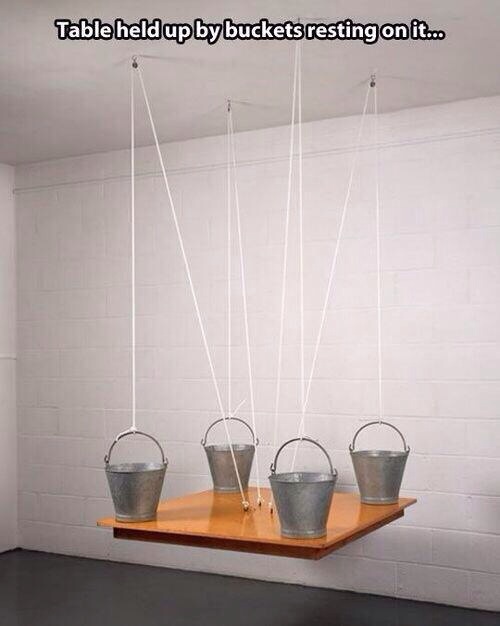

For 4 buckets, the total weight of one bucket and rope needs to be at least a little bit over 25% the total weight of the table and rope. All 4 buckets total is 100% the weight of the table, plus a bit. The buckets overcome the weight of the table (and rope), go down and lift the table and eventually come to a stop on the surface of the table itself. Elementary, my dear mavaction!What is the force of the buckets exerted onto the table top? :0corn
If:
N = total # of buckets
N[SUP]m[/SUP] = total mass of buckets
n = 1/N
n[SUP]m[/SUP] = n * N[SUP]m[/SUP]
T = total mass of table
t = n * T
r[SUP]a[/SUP] = mass of rope on bucket side of pulley
r[SUP]b[/SUP] = mass of rope on table side pulley
R[SUP]a[/SUP] = total mass of rope on bucket side of pulley
R[SUP]b[/SUP] = total mass of rope on table side of pulley
Q = Unknown additional mass constant to overcome equilibrium and friction coefficient of the pulley and the rope. See "little bit" above. (lol?)
q = n * Q
S[SUP]a[/SUP] = total mass of bucket side of pulley
S[SUP]b[/SUP] = total mass of table side of pulley
then to see results like in the picture:
S[SUP]a[/SUP] = N[SUP]m[/SUP] + Q + R[SUP]a[/SUP]
S[SUP]b[/SUP] = T + R[SUP]b[/SUP]
S[SUP]a[/SUP] > S[SUP]b[/SUP]
n[SUP]m[/SUP] + q + r[SUP]a[/SUP] > t + r[SUP]b[/SUP]
N[SUP]m[/SUP] + Q + R[SUP]a[/SUP] > T + R[SUP]b[/SUP]
Q > T + R[SUP]b[/SUP] - R[SUP]a[/SUP] - N[SUP]m
[/SUP]:0008

For 4 buckets, the total weight of one bucket and rope needs to be at least a little bit over 25% the total weight of the table and rope. All 4 buckets total is 100% the weight of the table, plus a bit. The buckets overcome the weight of the table (and rope), go down and lift the table and eventually come to a stop on the surface of the table itself. Elementary, my dear mavaction!
If:
N = total # of buckets
N[SUP]m[/SUP] = total mass of buckets
n = 1/N
n[SUP]m[/SUP] = n * N[SUP]m[/SUP]
T = total mass of table
t = n * T
r[SUP]a[/SUP] = mass of rope on bucket side of pulley
r[SUP]b[/SUP] = mass of rope on table side pulley
R[SUP]a[/SUP] = total mass of rope on bucket side of pulley
R[SUP]b[/SUP] = total mass of rope on table side of pulley
Q = Unknown additional mass constant to overcome equilibrium and friction coefficient of the pulley and the rope. See "little bit" above. (lol?)
q = n * Q
S[SUP]a[/SUP] = total mass of bucket side of pulley
S[SUP]b[/SUP] = total mass of table side of pulley
then to see results like in the picture:
S[SUP]a[/SUP] = N[SUP]m[/SUP] + Q + R[SUP]a[/SUP]
S[SUP]b[/SUP] = T + R[SUP]b[/SUP]
S[SUP]a[/SUP] > S[SUP]b[/SUP]
n[SUP]m[/SUP] + q + r[SUP]a[/SUP] > t + r[SUP]b[/SUP]
N[SUP]m[/SUP] + Q + R[SUP]a[/SUP] > T + R[SUP]b[/SUP]
Q > T + R[SUP]b[/SUP] - R[SUP]a[/SUP] - N[SUP]m
[/SUP]:0008
I didn't get it at first but after reading Jacks explanation it is so simple. God, I'm such a dope sometimes :facepalm:



For 4 buckets, the total weight of one bucket and rope needs to be at least a little bit over 25% the total weight of the table and rope. All 4 buckets total is 100% the weight of the table, plus a bit. The buckets overcome the weight of the table (and rope), go down and lift the table and eventually come to a stop on the surface of the table itself. Elementary, my dear mavaction!
If:
N = total # of buckets
N[SUP]m[/SUP] = total mass of buckets
n = 1/N
n[SUP]m[/SUP] = n * N[SUP]m[/SUP]
T = total mass of table
t = n * T
r[SUP]a[/SUP] = mass of rope on bucket side of pulley
r[SUP]b[/SUP] = mass of rope on table side pulley
R[SUP]a[/SUP] = total mass of rope on bucket side of pulley
R[SUP]b[/SUP] = total mass of rope on table side of pulley
Q = Unknown additional mass constant to overcome equilibrium and friction coefficient of the pulley and the rope. See "little bit" above. (lol?)
q = n * Q
S[SUP]a[/SUP] = total mass of bucket side of pulley
S[SUP]b[/SUP] = total mass of table side of pulley
then to see results like in the picture:
S[SUP]a[/SUP] = N[SUP]m[/SUP] + Q + R[SUP]a[/SUP]
S[SUP]b[/SUP] = T + R[SUP]b[/SUP]
S[SUP]a[/SUP] > S[SUP]b[/SUP]
n[SUP]m[/SUP] + q + r[SUP]a[/SUP] > t + r[SUP]b[/SUP]
N[SUP]m[/SUP] + Q + R[SUP]a[/SUP] > T + R[SUP]b[/SUP]
Q > T + R[SUP]b[/SUP] - R[SUP]a[/SUP] - N[SUP]m
[/SUP]:0008
Oh! Is the movie over already?
That's definitely not my work. :lol:I didn't get it at first but after reading Jacks explanation it is so simple. God, I'm such a dope sometimes :facepalm:


Seems to me that the ceiling is holding the table up.
:0008
Yeah, no shit? I don't get this thread.
Seems to me that the ceiling is holding the table up.
:0008
Yeah, no shit? I don't get this thread.
You are both wrong. Your physics teacher in college must gave hated you. Oh wait.


Idiots
It's in Outer Fucking Space
Actually, it's in a jail cell.
No carpet or TV?
I call bullshit!
TV is on the wall behind the guy taking the picture. The buckets are filled with cashews for the domino game.
seems to me the table and bucket weigh the same .....
push the table down 1 inch buckets would go up one each .... same weight balance


I've been letting this soak in now for quite awhile.....and I still don't give a shit.
Drrrrr....education is helpful in life....drrrrrr.....